Banzai!! Pipeline

This blog is dedicated to Advanced Squad Leader. It contains articles on tactics, storage, scenario analysis, after action reports, etc.

Wednesday, December 16, 2009

AAR: SP83 Boeinked

Nick Drinkwater
German Player [ELR 3, SAN 4]: Nick Drinkwater
British Player [ELR 3, SAN 3]: John Hyler

This is a fun mid-sized scenario that demonstrates the full majesty of a British set piece infantry attack with all the toys. The Brits need to take 4 multi-level stone buildings in the centre of the Board 46 village from a tough little German defense of 7 x 4-6-7, two Pak 40s and two Stugs with OK leadership to back them up. The Brits get seven Churchills of different varieties to assist them, all of which are veritable smoke machines. The best one is probably the single Churchill MkV with a 95* gun and S9 plus the usual ton of SD, SM and even WP - nasty for infantry if this one gets going. They also have four of the Churchill MkIV with a 57L gun and only limited HE, but again good SD and SM capability. Finally, they also have two Churchill MkVIIs with a proper 75 gun and again, you get it, more SD and SM capability.

In addition the Brits get a company of 4-5-7s, with a couple of mortars (for more smoke) and a couple of PIATs. Finally, they also receive two Bren As to do annoying scouty, encircly things. A good force and with the huge amount of smoke assets, one more than capable of getting the job done.

One of the cool things about this game is that the To Kill rolls of all the main AT assets will typically be either 9 or 6 for the Germans against the 8/11 AF of the Churchills and about 5 or 6 for the various Churchill guns against the 8AF Stugs - the PIATs with their TK of 16 are very powerful with a kill of 8, but the best thing here is that overall there is no surefire guarantee kill for either side, and hence getting optimum positions for rear and side shots may be important.

Looking at the board configuration, the fast way into the village is directly down the length of Board 46, but the Brits do have the open terrain of Board 44 to consider too - the Germans need to think about this as well. There is a good transverse hedge on Board 46 that can form a temporary halt line to the Brits, but it is important to think about where British armour could get to at the end of Turn 1 when planning the initial setup of the Stugs in particular. I was a little bit lax on this as I had left a Stug up there supported by a couple of squads, but John's opening turn moves were well planned and left my exposed Stug at the mercy of a Churchill IV by the end of Turn 1 - poor planning by me.

The rest of John's opening assault was textbook smoke, armoured assault and move and my only good shot from a level one, long range MMG resulted in a single pin. John sent a couple of Churchills down the Board 44 axis together with the two carriers whilst the infantry all solidly pushed hard into the woods and over the fields on Board 46.

A key moment happened early in German Turn 1 - my threatened Stug had already turned in Brit 1 Defensive Fire and on a laser thin LOS, had acquired the Churchill. In German Turn 1, I decided to gamble and stay where I was and take the shot and luckily found the APCR on a three - even hitting the hull, I was now able to put a shell through it and the first Churchill was dead - I then followed this up with a sniper that recalled the Churchill V - a HUGE move in the context of the game. Despite this John was still warily grinding onwards and all my overwatch squads were now smothered in Smoke - still no sign of either Pak 40s at this point though.

In British Turn 2, John pushed his carriers on into Board 44 where he found the first Pak 40 which was in a lateral orchard where it had a good view of the Board 46 area south of the hedge. Very frustrating for me as one of my traps was now blown with no results. Being wary of the newly revealed Pak, John manoeuvred another Churchill carefully out of sight, but this one also fell foul of crossfire from another thin LOS from my other Stug. My gunnery was outstanding in this game and this scratched another Churchill - three down, which soon became four when another was recalled with main armament failure.

On board 46, John had skillfully executed a smokey advance to the hedge and was now surrounding my forward Stug by a PIAT crew and two Churchills - it looked doomed, but I was able to put it into motion. Amazingly, he was able to find his SD as his first move point of his next movement phase, and I successfully evaded both Churchills - just as it was looking that I was going to be able to get out of jail free, John rolled a 4 and a 6 with the PIAT and that was that. The hedge defenders were now almost done...but not quite.

John had dumped smoke and then a squad and a half into CC with my only squad there, but in one of those cruel twists of fate, he rolled a 12 on his CC attack and I withdrew one hex to the south. Now, that squad was un-obscured by smoke and was in a position to cover a lot of moves by John's infantry over the open fields - it was a really critical move as the threat from this single squad held all John's infantry up for another turn at the hedge line, and the one squad that did try an run the gauntlet ended up broken. Now with four Churchills dead or recalled and the schedule pushed back a little, John was going to need to push hard from now on.

I had re-ordered the village defenders to try and get as much concealment as possible and also withdrew all the outlying defenders for the last couple of turns. In addition, I was able to drill a hole through one of the carriers with a Stug, but amazingly John pulled a two for the crew survival and the half-squad sheltered under their wreck. The other Carrier decided discretion was the better part of valour and hid for a while - more deadeye shooting when I needed it.

On Board 46, my heroic squad went down to a snakes at 1-hex range from the flamethrower - they were more plasma than atoms at the end of that one! With this, John was able to push his infantry over the hedge and two of the surviving Churchills ground forward to help them. At this point I dropped HIP on the other Pak which was in a board edge woods hex south of the hedge and two hexes from a stopped, lovely fat Churchill filling their gunsights. That beast somehow survived my Final Fire but went down to the subsequent Prep Fire as did a sixth motion Churchill adjacent but behind the hedge on a rate shot - as I said my gunnery was outstanding in this game. It was a good spot for the Pak and I think I faked John on it pretty well as he was expecting in the village as part of the last ditch defenses.

It was now desperation time for John with only one Churchill left and the infantry were starting to break a little too. Another snake-eyes survival from one of the Churchills ended in mutual destruction of the Pak crew and the vehicle crew, but by now, their job was done. John's infantry twice tried to push into the outer edge of the village but individual squads broke to some desperate shooting by my defenders and then John's FT failed on a 10 after that only one successful shot. In a final insult, John tried to enter another CC with one of my guys and rolled yet another 12 on his attack so I carried on withdrawing. At this point, John called it as it clearly wasn't going to be his day. Three of his squads were broken, one was dead, a couple were still laboring across the fields, the Flamethrower was malf'ed and he only had the single tank left. It was clear he wasn't going to push the Germans out of stone buildings on this day.

I liked this scenario - it is impressive to actually play a late war British attacking force, and John pressed on resolutely even after a couple of rotten early events went against him. The huge amount of smoke-making potential makes you have to think hard as the German defender on how to impact and delay the British and they will need to re-position their defenses at times and be flexible. As the Germans you definitely need to think hard about the opening turn one moves and where the British could be.

Anyway a fun one and I recommend you give it a go.

Cheers
Nick

Tuesday, December 15, 2009

AAR: SP10 Bring up the Boys (twice!)

Nick Drinkwater
Game 1:
German Player [ELR 3, SAN 3]: Mark Carter
British Player [ELR 3, SAN 4]: Nick Drinkwater

Mark and myself found ourselves playing this one as our introduction to MAGCON, a new event for ASL in Houston, held at a really nice hotel in Kingwood. We had an evening free to play this so we opted for a shorter scenario that Walter was running as a mini called BritFest (the second time we had run BritFest - last time it was Pyrrhic Victory). In this mini, a winning British and German player will be nominated by the accrual of Fun Points for doing things like killing tanks with Boys ATRs, or keeping calm under fire (not cowering etc) or even doing outrageous things like successfully executing overruns in Bren Carriers. Lots of fun and a good way to warm up for the weekend.

Anyhoo, "Bring up the Boys" was a good scenario for an evening's play, set on Boards 10 and 19. Its pretty straightforward - over six turns, five German tanks and six squads have to control a majority (7) of the eleven Board 10 stone buildings north of the East-West road and the curious walled enclosure in the B10 village. Stopping them from doing this are seven non-cowering British 1st liners, a Boys ATR, a LMG, two Bren Carriers and a 9-2. The challenge and interesting part of this scenario is that the Brits get to move last so the Germans may need to go into that last half game turn with possibly eight or nine buildings under control - as they are likely to be short of infantry by this point and the Brits may still access to the best mobility if one or both of their Bren Carriers are still alive, then any undefended portion of German-taken buildings could easily be re-captured by the Brits for a cheap and easy win.

The big trick in this scenario is just how much damage the Brits can inflict on to the Germans, who have to launch their attack across completely open ground on Board 19. In contrast the test for the Germans is to see just how creative they can get to mitigate against this. Most of the German armour has a 1,1 AF and so they need to sweat even the humble Boys ATR and LMG shots at close range, but the Brits only have two of these weapons at game start. The Brits can and should start at the tree line to try and inflict maximum cheap casualties but they need to balance this against being completely locked in on Turn 1 from aggressive VBM movement allied to large Advancing Fire Phase fire attacks. The Germans do need to keep an eye on casualties as they are outnumbered from the start and they will need those infantry to control village buildings in the end game. As a result, every aggressive move to enforce VBM needs to be examined carefully on a "risk vs reward" - there are no infantry to waste here, even lowly half-squads, so getting advantageous CC odds is important for the Germans.

The other thing the Brit needs to think about is how to use the Carriers - they could be used upfront to additional 2-2 shots against the open ground assaulting Germans, they could instantly de-bus in the village to give two more useful, tank-killing SW or they could just be held as a mobile late game reserve to go and reclaim all-important VC buildings in that last turn - all options are viable but all come at some risk. Interesting problem.

So in Game 1, Mark was faced with the challenge of the Germans. We were both a little rusty and Mark spread his attack out across the board to try and maximise the number of British squads he would see and also to disperse some of my return fire. My guys were largely up-front, with a couple of half-squads forming refused flank guards on the lateral edges of the village proper. The roadblock was in the obvious spot blocking the main round into the village through the woods, and my ATR and 9-2 and 8-0 & LMG were close by and centrally placed. Mark tried to use armoured assault and SDs extensively but generally rolled poorly where ne needed to roll well and vice versa. I was lucky to roll a three on one squad double timing in the open and that was crucially 1/6th of his infantry dead. Importantly he did not VBM freeze me anywhere in this turn, looking instead to reduce my thin khaki line by fire but that was largely unsuccessful, and most importantly my 9-2/ATR team retained concealment looking for something juicy to shoot at from behind in a future turn.

In Turn 2, Mark continued to push on and was able to VBM a squad but lost the follow-up CC, and worse, in an effort to remove a ? threat for good, stacked two squads next to them in woods, hoping to survive their shots and then wither me in return. Sadly this was my 9-2 and Mark's guys yahtzeed themselves to death on the resultant random selection once I had rolled the 3 for the 1KIA. Huge loss to the Germans and 50% of their infantry now dead - the only way Mark was winning this was by voluntary abandonment of the tanks but that was going to reduce their effectiveness massively. In the meantime my two Bren crews had dismounted and were in key buildings at the back looking threatening with their LMGs. To add insult to injury, Mark now moved a tank into a flanking position to try and envelop me, but this went down eventually to a Shock/UK kill from the 9-2 directed ATR shot in the rear - go Boys ATR, go! When another German squad was minced in brutally effective British fire, we called it as he was now down to 4 tanks and 2.5 effective squads vs an untouched British stone-building defense. My dice were hot, Mark's were average and we were done in four turns.

Game 2:

German Player [ELR 3, SAN 3]: Nick Drinkwater
British Player [ELR 3, SAN 4]: Mark Carter

As Game 1 ended quickly, and we only had limited time, we flipped it around and quickly played out a return, both feeling that we had essentially learnt what the scenario was trying to get over in Game one. This time around, I went strongly for the direct limited frontage schwerpunckt with the Germans to try and swamp and overrun just a section of the British line, but Mark also partially planned for this with a better distribution of the Brits than I had carried out in the first game. Mark's only weak point was that he had left a single Bren carrier in a position where I was guaranteed a good first turn Prep Fire shot at him with one of my tanks with an initial 7 To Hit - I'll take those odds any day. I missed him with the first shot, and even though he was able to squirt smoke at the start of his movement phase, I was still able to stick a tank shell through him in Brit Turn 1 movement. Apart from that stroke of good fortune, I can only say that my more direct attack was only partially successful - all my grandiose armoured assault and VBM moves had their accompanying infantry shot to pieces by withering British fire and at the end of Turn 1, I was down a half squad dead, a half squad back on the start line broken, and worst of all, a squad and a half as prisoners!

However, I had managed to get a tank into the 9-2's location (subsequently immobilized by them in Reaction Fire), but I managed to get 2.5 squads adjacent to him for some tasty follow-up fire. Now that he was locked, my guys took their chances in British Turn 1 and under multiple shots, critically broke and wounded the 9-2, generated a British hero but also were able to break the accompanying squad too. In a follow-up, I was able to get a squad onto one of Mark's guards and the tables were swiftly turned as I was able to free my guys to get a useful (yes, its true) conscript half-squad back in return - in hindsight, Mark's cool and collected guys should have massacred or NQ'ed my team to stop this happening.

Despite these initial losses, I knew I was now slightly ahead and I started to break through into the village and really started to use my tanks to aggressively encircle and enforce FTR on two of Mark's MMC. However, he was still definitely in it as I didn't quite have enough infantry to enforce all the gains I had made and I had to leave units in key positions to stand guard over isolated British MMC that I wasn't strong enough to break. By the end of Turn 5, I had seven of the requisite buildings and I knew that this would become eight as I had a broken half-squad trapped on top of a 1-2-7 crew in a one hex rowhouse. In addition, another crucial sniper double broke another British h/s and that was critical as I was then able to snag one more building for my tally. Luckily, I also had a fortuitous three on a advancing Fire shot on Mark's concealed 8-0 (that was denying me building control) and he was now unable to survive or dodge a subsequent advance by a German half-squad. However, Mark had also made a crucial mini-counterattack and reduced me by one less victory building and I was again down to the crucial seven. In his last move, he just had an encircled 2-4-7 (ex-carrier crew) left to try and enforce one more building conquest on me against a 2-4-7 and 8-1 and a 2-3-6 and 8-0. Sadly for Mark the 4-2 shot he needed to take broke him on the subsequent 2MC before he could advance in and victory just stayed mine. Phew.

Mark played really well in this apart from his slight set-up mistake with his other Bren, but in hindsight, the niceness of the British on NQ and this may have been the difference between victory and defeat - if both Carrier's had still been around to enforce late game house tagging, then I would probably have been too stretched to stop it after my turn 1 losses. I was lucky that only one of my five German tanks suffered a Breakdown and that was at the very end - the rest carried on gallantly shooting and encircling and did sterling service once the threat of the 9-2 had been diminished.

Good games from a fun opponent - thanks Mark!

Nick.

Thursday, November 12, 2009

Thunderbird Tournament AAR - Part II

Matt Shostak


Saturday I found that I had qualified for the prestigious main event, and my first opponent was Glen Gray, a very good player that I've tangled with many times before. We chose The Boszoki Relay and diced for sides, which gave me the Hungarians. This scenario is a different challenge than most. To win, the Hungarians must exit a certain number of their onboard forces through Russian lines. They have a relief force entering behind the Russians, trying to blast a hole for them to get through. Glen's setup looked really good. He had his 3 Shermans on opposite flanks at the board edge, pointing back toward my entry direction. They looked to be quite difficult to flank with my six Zryinis. Therefore I resolved to avoid them, and try to blast a hole through the middle. My onboard units I had set up in two groups, one in the center, and one to my right. The MVP for the Russians had to be the 50mm mortar on the hilltop, which could see quite a lot of the battlefield, and really put the hurt on some of my troops. Meanwhile, my 81mm MTR did relatively little, breaking a squad or two in the woods on my right flank. But Glen's Rooskies wisely avoided giving that mortar many opportunities. A highlight for Glen was popping one of my Zrinyis in the rear with an advancing fire shot, needing a 2 to hit and getting the snakes. Yikes. A key moment for the Hungarians was a sniper that picked off the Russian leader in the center. With no leader in that area, troops that broke didn't come back, and eventually that was the difference in the middle. The sniper also sent one of the Shermans home too. It was a hard-fought victory against a good opponent. If you haven't played Glen yet, you should definitely try to get him on your dance card for the Austin tourney.
1-0 in the main event and on to the second round.

Next up was Mike Rose from Kansas, a very knowledgeable and fun opponent. We chose Frontiers and Pioneers and I took the Germans. Mike set up a defense that looked about equally spaced between the two victory areas, but I think he used his dummies more on the rear area to make it look more robust. I decided to make a simplistic frontal attack rather than try to be clever with a flanking move. He had two forward stacks in the woods across the street from the main position, and they were acting a lot like dummies, basically ignoring my first moves right under their noses. Therefore I advanced a stack of 9-1, LMGx2, 4-6-8x3 concealed adjacent to them, in an orchard hex. I also had lots of other troops in the area, as all of my motorcycle riders had dismounted in this area in front of the main Russian position, with all of my tanks nearby in close support. In his turn, Mike decided to drop concealment and prep fire with those two squads at my concealed stack, an 8+0 attack. He whiffed with a 10, and the returning fire was a 36+0 on one stack. That and a snake eyes on the roll allowed us to simplify the board by removing one of the Russian squads. The other squad was hosed down with the ROF attack at 12+0 and wound up broken, and perhaps reduced as well, I can't recall now. Mike knew it was a risk by taking the shot and clearly he regretted it afterward. It essentially put him down 2 squads right from the get-go. Meanwhile one of my PzIIIs was dueling with his T-35 land battleship. The T-35 got off two shots in defensive fire, one each with the 45L and the 76*, but they were very low odds because of hindrances and other modifiers, but in the following prep he had a better chance. Nevertheless both shots missed, and the PzIII's returning shot struck home, only to come up a dud. The PzIII torched the land battleship in the following prep, however. Mike's defense had the land battleship and the KV in the center of the forward position, and his two BT's in the rear village area, although I did not know that to start because they were under concealment. He trundled the KV forward a bit to bolster the area just behind his two forward squads that had melted away like butter in a microwave, and my panzers generally kicked into motion to avoid a duel with the monster. The next turn a couple of them went on a wide flanking maneuver to try to get behind the main position and avoid the KV. The AA gun revealed itself and plinked a shot off the front of a PzIII. The landsers crept forward rather conservatively, and several were shot up by some well-directed MMG fire by the Russian 9-2. His KV backed off toward the center, and his BTs charged forward to engage my two flanking Pz38s. In advancing fire, one of the BTs broke its gun, so in my next turn I thought a bounding fire attack could finish off the BTs. One tank drove around behind both BTs and engaged the one with a functioning gun. That panzer wound up shocked. The other panzer drove in for the kill, only to miss its target. So a PzIII moved in also to help out, and also missed. Wanting to avoid losing tanks in the next prep, the 9-1 and one of his 4-6-8 squads CX'd over there and advanced in for close assault against the BT with functioning gun, but only immobilized it in CC. Things were looking bad for Mike. Somewhere around this time-frame I had inched two flamethrower teams close to his behemoth, the KV. There was some smoke cover for them, so they managed to get off a shot, and cooked the monster (needing a 4 on the dice). Faced with such dire prospects, what did Mike do? Well, he did what any self-respecting Kansan would do. He promptly repaired the gun on his BT and drilled the two panzers in front of it. His moment of glory was short-lived, however, as my infantry finally dispatched the other BT, and my shocked Pz38t, which had gone UK, finally recovered and destroyed the remaining BT. Meanwhile, back at the ranch, one of my tanks overran a Russian squad in the factory, and when the 9-2 and squad reinforced the melee but got stuck there, they were quickly finished off by a flamethrower shot which broke all of the melee occupants, allowing other Germans to advance in and finish off the Rooskies as they tried to withdraw. At that point, it was obvious that the Reds couldn't stop the Germans, so Mike conceded. Good game, good opponent, 2-0 and off to the semis.

I was matched up with Ed Beekman, who had just defeated my fellow road tripper Mike Seningen. Ed has been steadily improving his game, and I'd seen him play before, so it wasn't really a surprise to me that he was doing so well this tourney. I was in the mood for something short and easy because the hour was late and I was getting fatigued. We picked Bidermann's Escape (at least I think that was the title), which is a vanilla short scenario where the Germans have to exit three squads (Sdkfz 10/5s each count as a squad) through some Russians on a city/town half board. I wish I could give this game a long rollicking account, which Ed so richly deserves for his victory, but it was a short affair without many crazy swings. I had no answer for Ed's white-hot dice, which made quick work of my efforts to make any progress. At one point I had a 4 or 6 down 1 on a skulking squad, got some kind of check, which he passed. Meanwhile, his 2+2 shot at my 9-2 stack managed to break the leader and two of the squads. That's the kind of game it was throughout. I finally managed to exit two squads, but it wasn't as close as that sounds, as my last guys had zero chance of getting off. Good game, good opponent, and congratulations to Ed for the win, and for winning the final as well.

That left me 2-1 in the main event and 4-1 overall, a respectable showing. This was a fine tournament and well run. Most of the guys on these lists know many of the attendees, so you know it was a great group of guys. There were a few faces that were unfamiliar to me, and unfortunately I didn't get to play all of the guys, but that's just more incentive to meet up at the next tourney. Great job John Farris and Mike Rose for running this thing, and thanks.

Matt

Wednesday, November 11, 2009

Thunderbird Tourney AAR

Brian Roundhill


Qualifying Round 1 - Ed Beekman in 'Tanks But No Tanks'
I don't think I've ever played Mr. Ed before, so I was happy to get this chance. I'd seen 'Tank But No Tanks' played at a gameday, and it looked like lot's of fun, so I suggested it and Ed agreed. Polish infantry with 2 AT guns and an 81* mortar defending half of board 42 and board 49 against the invading Russians with 3 AFVs, and 2 more AFVs as part of their reinforcements. Our game was very different than the one I saw at gameday. For starters, we got the Polish reinforcements correct - they come in behind the Russians instead of behind the board 49 town. They caused Ed to hold a sizeable chunk of his forces back to prevent me from causing too many problems. Of his starting AFVs, 2 malfunctioned their MA in the first turn. Finally, his reinforcing AFVs found an AT Gun by driving into its hex. A lucky 3 and another good shot on an Overrun created 2 dead tanks. All of that together meant that Ed never had enough forces to properly attack my front lines, and the final nail in the coffin was a missed LOS and another 3 on the 2-2 shot.
Impressions - a wilder scenario than I thought because of the Polish reinforcements coming in behind the Russians. I think Ed should have created more havoc with his AFVs, especially the two with malfed MA's, but some great luck on my part eliminated most of the AFV threat.

Qualifying Round 2 - Mike Rose in 'Trigger Happy Joes'
Apparently Rick and I decided to swap opponents for our 2nd game. He played Ed, and I played Mike Rose in 'Trigger Happy Joes'. American firepower defending half of board 42(again) and the city of board 46 against the German onslaught. Americans have an M10, I think, at start, with 2 more reinforcing the action. The Germans have 4 AFVs, 2 Mark IVs and 2 JgPz tank destroyers. Looking at Mike's setup, it looks like the orchard hill is undefended, so his mines must be there. Therefore I decide to attack along my centre and right flanks, planning on coming through the huge woods overlay and into the city. Things were not to be so easy. Mike's mines were not on the orchard hill. Two hexes at the edge of the woods were mined, which caused me mch grief, and one early building hex as well. I made the best time I could, but by turn 4 was only at about the board join with a sea of green concealment between me and the victory building. On the right flank I was further along, but 2 AFVs had things bottled up, and my troops weren't sure where to go. Mike's AT Gun had made its presence known by knocking out a Mark IV, and was ready to blast the woods or anything trying to sneak around the woods. Since Mike had one unit on the edge of the city, and everyone else behind that edge, I decided my only option was to shift the point of attack. A JgPz rumbled up to VBM freeze his unit, but Mike opted to shoot and leave residual, so the JgPz remained parked one hex away to limit fire options instead. Everyone in the middle shifted to my left flank, which meant fewer American units between me and the victory building. The other JgPz drove down the streets, giving a low odds shot to an M10, which Mike declined, and frontal armour to the AT Gun. Driving past the AT Gun, Mike missed his CA change shot and later Intensive Fire shot, and the JgPz took out one of the American AFVs on my right flank, and had the other one in its sights. From here, I pulled out every trick in my bag. A 'faust got one M10, and the JgPz got the other. My troops swarmed at the victory building, and I got enough good dice rolls to break his MMG squad and 9-1, giving me a foothold in the building. But an upstairs HIP unit blocked me from getting to all his troops in CC, and I couldn't break everyone.
Impressions - Tough on the Germans. They have 6.5 turns to travel about 17 hexes and control a 6 Location building. At Turn 4, neither Mike nor I gave me a chance at a win, and it was only some good dice in the last few turns that made this game closer than it deserved to be.

Tournament Round 1 - Mike Laney in 'Encircle This!'
Since I got placed into the 'Main' tournament, Mike Laney got the honour of playing me. Somehow we settled on 'Encircle This!', a beefy conflict between the Russians and the Germans. The Germans must clean out 2 factories on board 51 that they start near, and get 10 VPs off the other side of board 49, including 5 VPs of Personnel. Laney got the Russians, and set up mostly in the back of the factories, with an LMG at 51Z4 and an MMG at 51DD2 looking for -2 and/or encirclement shots. Obviously Laney had a healthy respect for German firepower and my 9-2 leader. I set up my kill stack (two 467s, LMG, MMG, 9-2) to suppress the LMG, and everyone else prepared to storm across the streets. Early on, things went my way. Instead of going directly into the factories, I sent my forces wide and eventually attacked the side of the far factory from the W and X row back towards factory R2, sweeping through both in about five turns. My reinforcing halftracks unloaded and got ready to start forcing their way through the rubble while the Panthers and Stunty tried to find good positions to attack the factories. The Russian AT Gun popped up at 51AA2 and nuked the two halftracks, but my Panthers were thankfully safe. Laney's T-34s came on, took a drive-by potshot at my Panther in some rubble, and took up positions on opposite sides of board 49. After four turns, it appeared the Germans were running rampant. Only three or four squads made it out of the factories and onto board 49. The AT Gun had been bypassed and was out of position, and the only thing slowing the Germans down was the MMG and the T-34s. One Panther snuck across the road and took out a T-34, and the German infantry started working across the road. With Stunty and a Panther in good position, my only concern was exiting 5 VPs of Personnel. I had 5 VP in great position to exit, and another 3 VP that could make it off, so Laney had to do something to stop me.
First he rumbled his T-34 towards a better firing position, but a 'faust eliminated that idea. Next, Laney went into desperation mode. One squad charged across the open ground, and was shot up. Another squad also charged, and was similarly removed from the battle. Finally his last leader imitated the Japanese and scampered towards one of my troops, ignoring all my fire. This heavily panting, CX'ed maggot advanced into CC, avoided the Ambush, then failed to kill my troops. 4:1 at -1 back against him, and an 11 resulted in a much unwanted Melee. Laney then repaired his MMG, which prevented my backup VPs from exiting. 4VP of Personnel was not enough for the win.
Impressions - Sloppy play in the last two turns may have cost me, but time was running out and I rushed a little. I should have used the BMG and CMG to turn my Panther around, giving me more firepower against Laney's desperate charge. Also, I should have used the Panther sN to cover my 'extra' VP units dash for victory. Oh well, that's the way things go. This play felt tough on the Russians, but others feel it is hard on the Germans. I think Laney had some good ideas, but fell short in other areas. Rubble in 51U6 makes it harder for the Germans to get their vehicles into good positions, but probably wouldn't have made much of a difference. The factories appear to be mostly a red herring - the Russians can't hold on to them, and should be prepared to fall out and stop the Germans exit VC. If they get a chance, they can take back a factory and win that way.

Free Play - Mike Denson in 'One More Day of Freedom'
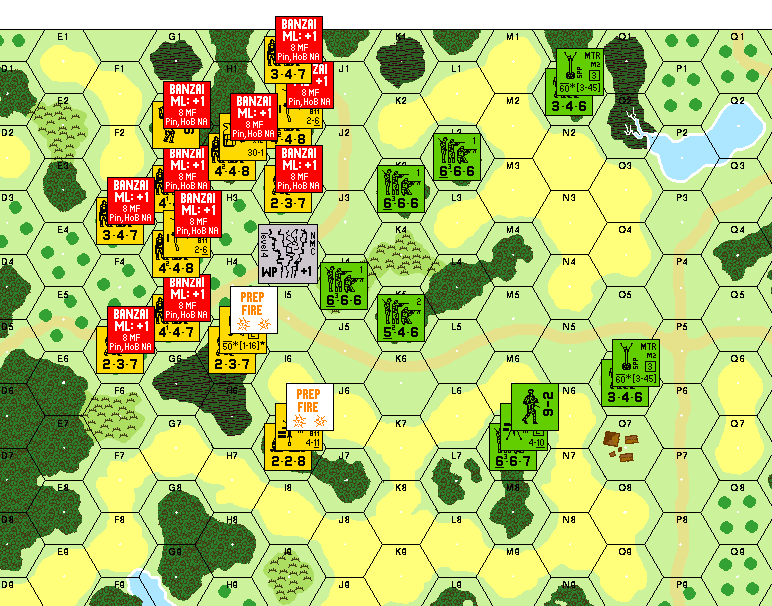
I was interested in some PTO, and Mike was interested in giving the Japanese a try so he could start to learn them. This looked the most straight forward of the PTO scenarios, so we gave it a go. Mike had some good Banzai's that resulted in several dead American squads, but his MTR ran out of SMOKE right before the last charge, and I was able to pack the final building for a win. Both of us learned more about the Human Wave rules, and I hope Mike enjoyed his first taste of the Japanese.

Free Play - Mike Rose in Hell and High Water
The Zombie Pack demanded a playing. I got the humans, who were trying to ferry civilians across the board 7 river to safety while holding off Mike's zombies as the shambled across board 19 towards their tasty food. Basically, a 2 legged puppy. The assault boats ferried everyone over in about 3 turns, and my armed forces sacrificed themselves at the chokepoints one at a time so the zombies had zero chance of reaching the civilians. Favorite part - sacrificing a unit to force 3 squad-equivalents into one hex, then dropping a DC on them. a 1KIA meant lots of scattered zombie pieces-parts. I am now one of 3 known people to play a zombie scenario. Shurtz and Rose played once at the Austin tourney.

Non ASL - Saturday night Bang. Fun and laughs.

Tuesday, November 10, 2009

Thunderbird Tournament AAR - Part I

Matt Shostak


The Oklahoma tournament is run a little bit differently than ours (Texas Team Tournament). Friday's games were used to qualify for the main tournament, which would occur on Saturday and Sunday. In conjunction with that, there would be an "other" tournament for the non-qualifiers. Since there were 24 players, that easily split into 16 for the main tournament and 8 for the other (or perhaps the "rest of the best" or something like that). Each of these tourneys was single elimination. Scenarios were to be chosen from a preselected list, which was available on the Oklahoma ASL website ahead of time.

First up for me on Friday was Patrick Ireland, and we chose "Out of the Shadows" from Dispatches for our contest. We diced for sides and he got the Germans, attacking. Highlight of the game for me was my Wolverine getting a lot of rate to erase a German squad that had crept a little too close to my frontline troops. The highlight for Pat was probably when his Panther lobbed a critical hit on the steeple of the village church, whacking my 9-2-led MMG and half squad, which had been harassing his troops quite effectively in the early game. Overall though Pat's approach was probably a little too cautious, and when my reinforcing squads arrived it was obvious that the Germans would not be able to seize their objectives. It was great seeing Pat again and I look forward to more games with this fine gentleman.
1-0.

Next was the redoubtable Greg Schmittgens from Kansas. Many of you know the Kansas guys from their repeated appearances at our tourney, although I think it's been a while since we've seen Greg. At any rate, he's a great pleasure to play, as are all the Kansans: very knowledgeable about the rules, good with his tactics, and all the while thoroughly enjoying himself. And why not? He acted the part of a crazed pyromaniac (is there any other kind of pyro?) in our game of "Penetrate This!" which I think is from Schwerpunkt. We diced for sides, and he got the defending Russians, armed with plenty of molotov cocktails, holding onto a couple of factories in an urban area strewn with rubble, in the late war.

I think this one may be a bit tough on the Germans, but others who played it at the tournament disagreed, so perhaps it's just a case of Greg making it seem difficult. The Germans have to take two factories, plus exit 10 pts. from the far end, at least 5 of which must be infantry. Fortunately, prisoners count in this one. Greg packed the factories with most of his force, with a couple of outliers guarding the flanks and looking for exit attempts through the constricted terrain. Early on I broke his MMG squad upstairs in one of those buildings, and mopped up at the next opportunity, taking them prisoner. I haven't done mopping up in a while. In general I thought that I didn't have much time to prosecute an assault on the factories, so I had to risk my two Panthers in the front line. The first one quickly succumbed to a molotov attack. The other managed to briefly freeze a squad, which allowed some of my assault engineers to get their foot in the door. Later this same Panther got drilled by a point blank APCR shot from one of the reinforcing T-34/85s as it tried to plow through another factory location. It seemed to me that, sensing victory, Greg pushed his Russians forward a bit in the factories to try to put the game away for good, instead of playing it safe and skulking like crazy and burning the clock. At one point I think we had each reinforced a melee enough so that I had an 8-0 and 3x8-3-8 against 2x6-2-8 and 1x3-2-8. That's working it old-school. This melee eventually went the Germans' way big time, and the factory defenses started collapsing. The endgame arrived with the Germans still needing to get one last factory location, but that was almost certain, and still needing to exit 2 or 3 points on the last turn. It's all a bit of a blur, but the Germans just pulled it out, barely. Great game. 2-0 and ready for the main event.

End of part 1.

Wednesday, November 04, 2009

Military Museums in England

Nick Drinkwater

Tom and anyone else going to England....

Depending on your schedule and location, if you are confined to London, then first and foremost I would recommend the Imperial War Museum which is on the south bank of the River Thames in central London. It is an outstanding collection with a ton of funky stuff, and best of all its free! Leave a day for this one - its big. Its exhibition on the Victoria Cross winners is very good.

http://london.iwm.org.uk/

Second on my list in London is the National Army Museum on the north side of the Thames in Chelsea. Smaller than the IWM, but very compact it deals solely with the British Army through the centuries - this is very cool and there are some cool exhibits on Waterloo, the British in SE Asia in WW2 etc. Definitely a long half-day here and a good bookshop too.

http://www.national-army-museum.ac.uk/

Another half-day trip (2-4 hours long) is the Cabinet War Rooms - excellent snapshot of Blitzed London with a new annex that deals solely with the life and times of Winston Churchill. I was there in the summer and I loved it - also got to meet Private Harry Cohen of the 4th Indian Division who survived Cassino...a very lucky chance encounter. This is actually a branch of the IWM.

http://cwr.iwm.org.uk/

If you are into aircraft, then the RAF museum in Hendon, North London is a must see. Outstanding collection of WW1, WW2 (lots including lots of captured German aircraft - Stuka, Me 109, Night-fighting Ju-88) plus post-war collection. One of the best there is a Halifax they pulled out of a Norwegian fjord...too damaged to restore, it is left in an 'as is' state - very poignant. Another good VC collection here. This is a 2/3rds day trip plus metro travel to get there but it is really cool. There is an annex to this in the English midlands at Cosford - not been to that yet.

http://www.rafmuseum.org.uk/london/index.cfm

The final London WW2 thing to see is HMS Belfast, another annex to the IWM - this is a floating heavy cruiser docked permanently on the Thames near Tower Bridge, access from the south bank. I've not been to this, but I've heard good things.

http://hmsbelfast.iwm.org.uk/

Outside of London, there are several excellent collections scattered across the country (Fleet Air Arm Museum in Somerset, National Army Air Corps Museum in Hampshire etc) and these are a bit more specialized - you can hunt them down online if you are in the area. However, three stand out in particular - the IWM has a newly opened branch in Manchester - not been there yet, but saw a documentary on it once on TV - looks way cool.

The IWM also has another branch, this time in Duxford which is ten miles south of Cambridge (about 50 miles by major highway north of London) - another brilliant museum, largely dedicated to flying. It has an excellent collection of working WW2 aircraft and has its own hall for the American Air Musuem. Has a working B25 in here, a Blackbird and a lot of really cool WW2 aircraft plus a Battle of Britain hall. In addition, they also have a Land Warfare Hall, probably second only to the Tank Museum. There is a strong collection of WW2 German and Russian tanks in here particularly and they have shows commonly for both the airdays and for running tanks. Really very, very cool and a very full day to see it all - also see the American Cemetery just west of Cambrige - approx 2000 (mainly) airmen are buried here: Cambridge is right in the heart of the old US bomber airfield area - a sobering but evocative way to finish the day

http://duxford.iwm.org.uk/server/show/nav.55

Finally, there is the Tank Museum which is about 80 miles SW of London - the best thing for treadheads in the country. You've seen lots of photos but that does not do it justice - outstanding museum. A bit of a pain to get to by public transport as its right in the heart of the army's training grounds, but simply awesome. Well worth the trip!

http://www.tankmuseum.org/

So there you have it, a week of interesting things for Americans to see that doesn't involve Bath, Oxford, Edinburgh or the Queen and 'those cute little dogs'.

Thursday, October 29, 2009

AAR: ITR6 The Ceramic Factory - Response to the Response

Nick Drinkwater

Chris, Matt, Zeb.

Agreed with everything you've all said. With these equal split victory objective games, as the defender, its perhaps a little easier as you really do get to fight the ultimate battle on a battleground and force balance of your own choosing (try AP20 Victory is Life as another example of this where the Russian attackers have to choose force balance quite accurately from the start). Looking at the two factories, I opted to defend the smaller of the two, primarily as it sits up against a board edge and hence the Russian has only three main approach routes - the big factory can easily be surrounded from all four sides by the Russians.

The key decision that the German has to make is how to split his force and yet make it look to the Russians like he has really divided his units in half. I did this by approximately splitting my force numbers 60:40 but in terms of concealed stacks made it look more 50:50. As well as this numbers balance, I also went for a force quality imbalance as all my crappy 447s, 237s etc went in the big factory with only a couple of 4-6-8s to stiffen the line. The small factory was jammed up with all the 548s and 468s so basically in FP terms and morale quality of troops it was more like 70:30. All the heavy SW (HMGs and MMGs) went in the small factory and six of the seven FBL were all placed in the small - all of course unknown to Chris at the start of the game where everything looked about equal under their concealment counters. Finally, all of the mines, wires and roadblocks, a HIP squad, MMG and leader and one of the two AT-Guns were placed to help make the small factory a really tough festung for Chris to take out, but still with the intent of leaving enough initial doubt in Chris's mind on the way things were resolved. Chris would only get to see the wires, and find the mines, and bounce out from the FBLs when he really got upfront and personal - by then I was hoping he was committed to the big factory attack with enough numbers that they might just be too late to come and hurt me in the endgame in the small factory.

And so it proved. Chris did a good job at bottling up the big factory and by G Turn 6 I was down to a squad, two leaders and a crew. I then had the inspired idea of using the sewer to pop up concealed with two units across the other side, but of course I rolled the six to get lost in the sewers, and ended up placed outside the factory by Chris. Very typical. However, the small factory defence of 4-6-8s and 5-4-8s in multiple FBLS with tons of support weapons and good leadership was just too tough for Chris to overcome, especially after one of his FTs choked on its last shot in the last turn (after at least 14-15 shots with no Xs prior to then). Chris tried to bust a hole into one of the FBLs in the last turn with an IS-2 but I calmly revealed my last hidden AT Gun and DI'ed the crap out of the beast to stop that one in its tracks. I was also successful in finding ATMM and fausts when needed (one particular 237 hs first un-HIPed to pop a faust through a IS-2m, got sniped and broke, rallied, popped out to slap a mine and burn a ISU 152 only to go down in a hail of gunfire as it charged up an open road to try and rejoin the fight for the big factory. Posthumous iron crosses with Oak leaves and diamonds for those boys). Luckily I didn't get to bounce a faust of a IS-2m.

The only real downside I could see to the small factory is that there were no internal walls to shield me from Russian 10-2 killstacks once they had entered the perimeter, and also help provide places to rout to safely. This was an issue in the last couple of turns as Chris was able to 'touch' me with a brutal 10-2 monster a couple of times, but the extra FBLs really helped offset this allied to a couple of lousy high rolled shots. A timely berserker also helped me here as that soaked up some more FP desperately needed elsewhere, after also going on a rate spree with a MMG and breaking Chris' other FT squad who then routed back and got hurt by some mines. But at the end, Chris had unluckily ran out of options to bust units into the forts and he was faced by a wall of pinned defenders to get through before he could even try. We had a couple of fun things - the sewer game winner / game loser moment of course, an Improbable Critical by an SU152 on a JgPzIV, another improbable critical from a manhandled 76L Art gun on my only decent squad in the big factory, stupendous runs with both flamethrowers, and the "little 237 that could".

It was a lot of fun, but with the setup advantages of the Germans allied to the toughness of SS in forts at the death, I'd probably rate this 60:40 German. Or I would, if the low ammo rule wasn't there as Zeb described - Chris didn't do a lot of cheap 2+5 shots to try and trigger this and so LA only applied to me on T5. However, as Zeb pointed out, if he'd gone hell for leather for it as the rule encourages, I'd have been there a lot earlier and that would have made a difference - still a bit pro german but the loss of the HMGs early especially would be huge. Zeb's change with maybe a couple less FBLs would be good things to try.

Cheers
Nick

AAR: ITR6 The Ceramic Factory - Response

Zeb Doyle

Totally agree with Chris: The Ceramic Factory is a big fun scenario that might favor the SS a bit. I played it as the Soviets against Eric's SS. He opted not to defend the smaller factory with anything other than dummies, and that allowed me to really focus my entire force on just one objective. In hindsight, we both agreed that made my job quite a bit easier. It was still tough going for my troops and it came down to the last turn before I could clear the large factory for the win. One major problem for me was the German assault guns: Eric parked them all in the festung factory and as I killed them off with IS-2s and FTs, they caught on fire and really hampered my attack. This led to a bit of a stressful end game for me when my approach to the last SS stack was narrowed down by the burning factory to just two ground locations and the roof.

The only thing I didn't like about the scenario was the SSR about the German ammo shortage: after 12 German sniper activation attempts, the SS suffer from Low Ammo. As the Soviets, I set up to make it impossible for a painful German sniper attack to occur, and started taking every single AFPh 2+3 and 4+4 I could find. With a 5 German SAN, Eric was faced with Low Ammo by turn two, and that really hurt him with a lot of Wehrmacht MGs X'd out by game end. It felt pretty cheesy and seemed weird that the German ammo expenditure was up to the judgement of the Soviets...seems like it would have been better to give the SS Low Ammo after X amount of Soviet sniper activation attempts. That would have felt (at least to me) the Germans would be saving their shots, waiting for the 'whites of the eyes,' etc, and fit the mood a little better.

Still a fun scenario if you are in the mood for a close-in urban slug-fest. Another fun one that has a slightly similar feel, albeit less claustrophobic and with more maneuver, is FT106 Counterattack Along the Danube. This one is 2/0 in favor of the Soviets though, and might be tilted towards them balance-wise just as much as The Ceramic Factory feels tilted towards the SS (either side can win but the favored side does have an edge IMHO). I'm pretty sure I saw FT106 being played at the Austin Team Tournament.. .anyone have any comments on this one?

Zeb

AAR: ITR6 The Ceramic Factory

Chris Buehler

It took us about 9 to 10 hours to play the Ceramic Factory. We started at Tom’s on September 24 and finished at Nick’s last night.

It’s a great scenario with quality troops, large forces, and very tough decisions for both sides. Particularly, how to split your assets between the two factories for both the Russian attacker and SS defender. Even with Nick’s SS troops walking away from the large victory location factory on the final turn (actually, they got lost in the sewer and wandered away from the factory), I could not dig the SS out of their fortified holes in the smaller factory. In retrospect, Nick played the set-up shell game to perfection and had me believe his force was more concentrated in the larger factory. I fell for it sent more troops that way, falling a bit short on the firepower necessary to take the smaller factory. Well played Nick!

With respect to balance, ROAR currently shows 13 to 6 in favor of the SS. While I feel both sides can win the scenario, it really comes down to whether the Russian player splits his force in an appropriate manner to assault both take both factories. You do not have time to deal with them one at a time.

Chris

Sunday, October 18, 2009

AAR: DB76 Out of the Shadows

Scott Bell

Americans: Scott Bell
Germans: Hondo Nelson

Yesterday (Saturday) at San Antonio ASL day, Hondo and I had a chance to square off in a "new" scenario from "Dispatches from the Bunker." It was the first time we have had a chance to play against each other, and it was nice to play something that few if any players have played yet. This scenario just came out.

"Out of the Shadows" is a scenario set in Allan, France (August 27th) 1944. The Americans are composed of the 3rd Infantry Division along with support of Company B (Tank and Tank Destroyer Battalions). The Germans have the 11th "Ghost" Panzer Division along with Grenadier Regiment 757 and Grenadier Division 338.

This battle takes place on board 53, where the Americans are defending large buildings in a congested town. The Americans can also win by exiting > or = to 16 VP's off the north edge of the building. Absent poor planning on the part of the Germans, the American exit strategy is probably unlikely, so the battle comes down to control of victory buildings or the Germans earning > or = to 35 CVP by games end.

In this battle, the Americans, who initially control the town, strategically engage in a fighting withdrawal that is timed in order for them to maintain control of the majority of the buildings within the town at games end. I was the Americans in this scenario. I started out the battle with a 9-2 leader in a 2nd story building, a 6-6-7 squad, along with a MMG. Unfortunately for me, one of Hondo's Marder tanks quickly and improbably locked onto the building I was in (long distance), and broke me after the 1st turn. This prevented me from whittling down Hondo's forces as they approached the town. I was able to strategically organize my forces to where I gradually fell back into what might be described as a "slice of pie" defensive line. The long lines of the pie slice that met at a point, were roads, which I controlled effectively with MG fire. I controlled one major line with a squad and a MMG (fire lane). The other I controlled with MMG fire from my 9-2 leader and a 6-6-7, who had previously broken but were now rallied, along with tank support.

At the mid point of the game, I appeared to be in control. Hondo was unable to breach my defensive line which was quite strong. At turn 5, I had broken much of the German infantry, and had seized the initiative to where I was somewhat on the offensive. One could probably make an argument that I should have stayed put, but my defensive attack against Hondo's infantry had gone well, and I did not want to let him regroup; therefore I went after the wounded prey. THEN IT HAPPENED TO ME.......

This game "in the form of some critical dice rolls" had one of the most spectacular reversals in fortune that I have ever been a part of. The reversal involved the battle of our tanks. In the armor engagement, I had one (1) Sherman tank and three (3) M-10 TD. Hondo had one (1) Panther and two (2) Marders.

During the key tank engagement, I had managed to gang up with my Sherman and two (2) of my M-10's against the Panther tank. That was the good news (for me). The bad news was that due to the congested terrain of buildings and fire that had spread, along with his PF equipped infantry, I was only able to get front shots on his "in motion" Panther. I kept getting hits on the Panther with APCR (which I amazingly kept), but could not knock it out. I then switched my strategy to an effort to immobilize it, but could not get the required rolls to do that either. Hondo was feeling the heat, and realizing that I would eventually be successful, brought a Marder into the battle, in an attempt to draw fire away from the Panther. My Sherman tank pivoted, missing during Defensive Fire, and destroyed the tank on my next PFPh. Now I was really feeling good. I felt like I was in complete control of the infantry battle, and appeared to be improving my situation with my tanks as well.

Quite suddenly, my fortunes changed. It began when Hondo "killed" my 9-2 leader with a sniper shot. He followed this with an unlikely 4 hex away AFPh shot by a German Squad with a Panzerschreck, against my Sherman tank. Hondo needed a "snake eyes" to hit, and that is what he got. One Sherman destroyed. Next, the "in-motion" Panther took a shot at my M-10. Hondo rolled 3 dice, and got "triple snakes." One M-10 destroyed. Hondo smiled at his fortune, and said he was "going for it." He was "feelin" it, and he was on fiyaaa. The Panther took an "Intensive Fire" shot with 3 dice. The dice came up as 1, 1, & 3. A second M-10 destroyed. In the course of one turn, I had lost 3 tanks and my 9-2 leader. My misfortune was not over.

Now we switch to the infantry battle, where I had previously seemed to be in complete control. Earlier, I had advanced several American squads into the hex with the Panther as part of my combined arms attack which was designed to ensure that I would get the Panther. I forgot about the Sn, which I now call the "Fritz." I have only faced this defensive tank weapon probably on 2 other occasions, and I should have remembered it since it was devastatingly effective both times. I got "fritzed." The weapon broke my entire stack, and Hondo effectively closed in with nearby German infantry to finish the job.

I was in trouble now. I had complete control of the victory buildings, but my losses of tanks had now put me in a position to where Hondo could win by CVP's. Hondo had secured 21 CVP's in that one turn with just the 3 tanks kills, alone! I immediately began to retreat towards my defensive lines to try and stem further losses. This scenario would now clearly come down to CVP's. Hondo became the hunter, and I became the hunted. The Panther ruled the battlefield, and I was in full retreat with no answer for that tank. The "only" friend I had at this point was time. I had a remaining strong stack of troops which had stayed with one of my leaders in the course of falling back. I made an unintentional error of leaving them stacked (I forgot to spread out during the Advance Phase) and Hondo moved his Panther into my hex to freeze me, while his weakened but still viable German troops closed in for support. I managed to "immobilize" the Panther and knock it out in close combat (finally), and barely held on in close combat against the German infantry as the game ended. We were still engaged in CC when the game ended.

I had just managed to squeak out a "win" by only 3 CVPs. That was an amazing turnaround for a game that prior to turn 5; I had seemed to be in control.

This scenario was a lot of fun, and I would recommend it to those who are looking for something interesting to play. It is found in the newest "Dispatches from the Bunker" (No. 29, I believe). It is Scenario # DBO76. It was a good match-up for Hondo and I; who have styles of play that are somewhat similar with regards to aggressive play. Hondo played a very good game, especially at the end when it mattered most. He was aggressive when he needed to be, and just "barely" came up short. The Panther tank was amazing in this scenario. I delayed engagement with it as long as possible, and when I did finally engage with it, I did so with numerical superiority that included a 3-1 advantage in tanks, with engineers and a hero with a bazooka in support. The Panther tank fought back with defiance and determination, and it was amazing for both of us to watch. The Panther fought heroically, and its story would seem to be consistent with some of the great individual heroic actions of WWII that we have all read about. It was a pleasure to watch, even though I was on the wrong end of that "beatin' stick."

I would like to thank Hondo for the excellent game, and I look forward to playing him again, soon. I hope you enjoyed reading this, just as I enjoyed reliving it via this review. This game is one that I will not soon forget.

On a final note, I am eligible to "retire" from SAPD in 4 days. I will not be leaving immediately, though I do expect to "wrap up" my career in the next couple of years, which I'll work in order to supplement my annual pension payout during retirement. I mention this, because I look forward to playing a lot more ASL in retirement. I am planning upon doing a lot of traveling in retirement, which will include traveling to play ASL across the country, and across the world. I am very excited about that, and I feel very fortunate to be able to participate in a hobby (ASL) that I enjoy so thoroughly. I thank "all of you" for being a part of that.

Regards,

Scott

Monday, July 27, 2009

AAR: RPT14 Keitel & Cox

Nick Drinkwater

German (SS) Player [ELR 5, SAN 2]: Mark Carter
American Player [ELR 4, SAN 2]: Nick Drinkwater

Mark and myself hooked up with this one as a last minute substitution for our original all-infantry choice as Mark wanted to practice more both as the defender and get some more practice in using AFVs. This 4.5 turn scenario out of the second Rally Point pack appealed as it had a Tiger(!) and a couple of Shermans stiffening an attack by 10 x 6-6-6s to eject a bunch of 7 x 5-4-8s from a stone Italian town in mid 1944. The scenario is set width-wise on one of the new SK boards and for victory, the US have to ensure that they control three multi-hex buildings that span the middle third of the board AND prevent the Tiger (with functioning MA) from being within four hexes of a central crossroads (hex Q5). These are pretty tough VC for the US, as they have a lot to do to dig out tough defenders in ideal terrain and also be successful in a game of cat and mouse with the Tiger - ROAR currently has this as 4:17 US to German, probably reflecting the problems of playing with Shermans against a markedly superior tank AND clearing three stone buildings in 4.5 turns.

To help Mark, we had a thorough discussion on all aspects of the units that has been provided, particularly with respect to the merits of the armour assets and also the importance on understanding the key issue of timing and the pace of the defense vs the required victory conditions. As it stressed in the VC that the US will lose if the Tiger is in the correct area with a functioning MA at game end, Mark quickly grasped the huge potential of the game winning aspect of this one piece and its need to be preserved. This was reinforced when he saw the problems of having M4A1 Shermans with their 75s - base To Kill of 14 will be bouncing off the 14/11 frontal armour on almost every shot and even side shots would need a six. Of course, the reverse was not true as any shot from the 88L was going to blowtorch through my tanks. Hence the Tiger was going to pose a problem for me, compounded by the better Tiger morale and the presence of the sN to throw out smoke when needed to get out of a sticky position. Mark swiftly picked up the nuances of all these aspects in the pre-game chat, but we also took time to make sure that the one saving grace of the Shermans was noted: the white square nature of the ROF of 1 which offered the potential for both improved gun duel chances and the chance for multiple hits, particularly threatening if the Shermans could be manoeuvred successfully to do the "dance of death" on the solo Tiger. More on this anon!

Mark swiftly set up a forward defense with the bulk of his troops stiffened by a line of LMGs and MMGs at the rear, covering the main lateral road I was going to need to cross. Setup meant that I was also setting up onboard and in this case, I had the advantage of setting up second - with Mark's forward defense I was able to deny concealment to 70% of his force at the cost of two revealed half-squads myself, and was able to place a menacing "?" stack within two hexes of the most forward of his troops. I also tasked my Bazooka squad to run forward on my left flank to start to threaten his Tiger and get him moving from its rear area position.

Turn 1 was completely ugly for me as Mark's first shots of the game were 2, 5 and 4, and of course being 6-6-6s I went rolling backwards on both my left flank and centres and I swiftly had 3.5 squads broken on Turn 1, including my only MMG and bazooka squads. Luckily my right flank concealed 'creep' stayed intact and the two Shermans were still healthy as it otherwise it could all have been over very quickly. By the end of Turn 2, I had been able to crush the two squads and leader Mark had on my right flank through concealed ambush and CC so things had started to even up a bit, even though I couldn't rally a unit for squat (including and especially annoying the Bazooka squad). A key move also happened in Turn 2 when a 7-0 went berserk on a rally - this was looking disastrous for me, but actually turned out really well as he charged Mark's MMG team tasked with solely holding out in his left rear defense line. Just before he went on his mad dash, I was able to dump a Sherman WP shell on top of the MG nest and this was meant my 7-0 survived his dash for glory and completely locked up his MG unit. I was thus able to get a 6-6-6 into the berserk CC location unscathed and the first victory house was mine. However, I still had two to go and the problem of the Tiger to solve and time was running out and still all of my first turn morale check failures stubbornly refused to rally.

Mark kept the pressure on by keeping my Baz team DM through movement of the Tiger (but wisely not using his MA on a wasteful shot after a discussion) and then pushed him back to a position where he could support the defense of his rear right house, the most difficult for the US to attack. Turn 3 saw him start to fold the defense backwards to the far side of the lateral road, but I was able to pin then destroy a half-squad while he was doing that - he had now lost 3.5 squads but I only about 5 squads in positions to effect the outcome of the game and the Tiger was still alive. In my Turn 4, I was able to eliminate another SS squad in CC (gotta love that 6 to 5 CC odds) and most importantly I saw an opportunity to threaten the Tiger from opposite sides with some cautious lateral manoeuvring of a Sherman. This was a bit risky as it meant I had to unbutton for some road bonus points and also I needed to risk an ESB for an extra half MP to get me in the perfect position, but this left me with a snakey 9 hex LOS through two orchards to the back hull of the now motion and sN smokey Tiger. At the same time, I pushed the other Sherman against the direct opposite facing of the Tiger to snap shut both sides of the vice.

In German Turn 4, Mark's last outboard infantry units were shot down when trying to retreat and he was left with a solo concealed 548 in the last victory building and the Tiger vs approximately 5 of my squads and the two encircling Shermans. We had a long discussion about the options open to the Tiger from here. If it could survive the two incoming Sherman shots it would probably mean victory for Mark as I would be left doing the chasing and needing bounding fire shots in my last turn for the win. If it stayed, however, I would still need to pull out some good shooting as Mark had smartly rotated the TCA opposite to the Tiger's VCA, meaning that both of my Shermans could still yet hit one part of the superior 11/14 armour rather than the 8 rear armour facing. If he wanted to escape there was also a chance he would fall victim to a 9-1 led streetfighting attempt (5 to Immobolize, 4 To Kill assuming PAATC was passed), but this was unlikely. As he was in Motion, shooting first at a Sherman was a possible but not great option, as I was always able to out gun-duel him first, so another sN attempt and then move was deemed to be the best bet. Mark was able to get the Smoke down so my sneaky Sherman was looking for a 5 To Hit and hopefully a 2,2 would come up as that would be a multiple hit in the Tiger's rear, as opposed to a single shot on its frontal turret. Roll the dice....and yes, you guessed it right, I called it correctly - a 2,2 was smiling back at me! Needing a 7 To Kill from the two attempts, I rolled two 3,3s in succession and Mr Tiger and his crew were very dead.

The concealed 548 was the last hope for victory but these went down to the first shot they took when Mark's dice hurt him some more and they failed a 1MC. Game over and a win for the good guys.

Mark played this scenario well and I hope he picked up some useful ideas and thoughts on how to defend, particularly during short scenarios when the need to really thick tactically about the opponents VC and his timing is critical. This scenario with its low AFV numbers also demonstrated the importance with vehicles to always try and keep in mind that its not necessarily what your opponent is doing with his tank this turn that you need to worry about - its where and how he'll be placed next turn to impact you which is the key thing. This takes some thought and I'm still on the learning curve on that one myself - I think it is this ability that makes the difference in armoured play (for example and this is a long list) that the Matts, Mikes, Jeffs and Zebs of this world possess.

So a fun ans small learning scenario played on the scarily 'open' SK boards with no hedges and walls to duck behind. I think ROAR's number of 4:17 is a poor reflection of this scenario and I do wander if that is more a reflection of the inexperience new players have when trying to use Shermans against a big cat. The Germans can be quite brittle, and Mark agreed that they may be better set up in a rear defense next time, as once one or two units succumb early to the US, there are a lot of opportunities for them infiltrate and surround outlying SS defenders who won't be able to get back and hang tough for the final turn defense. Mark's enthusiasm for the game is infectious and he's a willing learner and I would encourage anyone to play him as they will have fun! Also, thanks Mark for acting as host - wonderful to come and visit you and great burgers and beer man!

Thursday, July 02, 2009

2009 Texas Team Tourney AAR

Zeb Doyle

Every year, the Texas Team Tournament is my favorite ASL event by far, and Rick has never disappointed yet. This year was one of the best in recent memory for me, and I want to say thanks to everyone that managed to come and turn it into such a fantastic event. Congratulations to Mike Seningen and Chris Buehler for taking home the serious trophies, and to Jim Ferrell as well. Making it to the finals four straight years is an amazing feat. Most of all though, thanks so much to Mr. Rick Reinesch, the man who makes it all happen and even manages to make it look easy. I hope everyone knows just how lucky they are to have such a premier tournament right in our own backyard!

One of the best parts this year was just showing up and getting the swag bag. David Longstreet once again delivered some very cool ASL gear, this time in the form of a very cool LOS checker that will be the envy of everyone who missed out. Other highlights for me were seeing (and playing) lots of out-of-staters. Of my six games, four were against fresh faces, something that always adds a bit to the excitement. Another cool occurrence was looking at the leader board late Saturday and seeing a number of new names up there. Congratulations to people like Ed Beekman, Mike Denson, Rob Burton, and especially Hond Nelson! It's a real testament to the strength of our club that we have so many players capable of tearing off multi-win streaks against some tough competition. I could go on all day talking about tournament highlights, but instead let me just say that the unfortunate few who couldn't attend, like Nick Drinkwater and Tom Gillis, were conspicuous by their absence. We really missed you guys. Now, on to a quick account of some of the action:

Going into the tournament, I had harbored some illusions of competing for the Major Johnson, but I got stuck at work Thursday and ended up not making it to Round Rock until Friday morning. There, Rick quickly and efficiently paired me up with Chris Buehler. I felt a shiver run down my spine when I first saw my opponent, but I didn't realize I was actually in the presence of greatness. In fact, we ended up playing the rather smallish scenario A69 Broich Bash. Weighing in at six turns, fourteen total squads and seven vehicles, I can't claim to have been much help to Chris in his quest for the Major Johnson. The dice gave me the defending Germans, and my troops hunkered down to defend the stone buildings as per the VC. Chris brought his Americans in on the west side, which wasn't much of a surprise, and by turn two bullets were flying back and forth. Chris played a good game, but despite numerous attempts, didn't manage to get any smoke down through the first three turns of the game. Given that I had 7ML units in stone buildings and he had 6ML units coming across open ground, that made things very tough. The two big opportunities Chris gave me both involved stacks of Americans moving in the open, and the resulting 6-2 and 8-1 shots were both snake-eyes. That amazing display of skill took a lot of suspense out of the game, and although some late-game smoke finally made an appearance, I managed to comfortably hold enough buildings for the win. Fun tournament scenario, but not a lot of depth to it, so I likely won't play it again.

Next up was Ed Beekman in FrF20 Adolf's Amateurs. This scenario represents an interesting situation, with some early-war SS fighting Russians in far northern Finland. The SS are Green, poorly led, and have only the advantage of numbers, ELR, and increased broken ML over their Soviet counterparts. The Germans are trying to cross a stream and capture buildings and bridges all while killing Russians. Both sides get some tincan tanks, which also feature in the VC and give you a strong incentive to keep them alive. Dicing for sides, I got the Russians and promptly set up a defense along the stream to stuff the Germans. There are some pregame blazes I got to place, and the SSR-induced mild breeze allowed me to drift smoke along the level-zero front lines. This would give me plenty of cover while allowing for point-blank unhindered fire on any SS foolish enough to move into the level -1 stream.

This probably would have worked well, but Ed decided to be aggressive with his tanks. This really caught me off-guard, as the two German vehicles have at best 1AF, and represent two of the eight points they need to win the game. It ended up being a great move though; I had multiple opportunities to take them out with MTR and machine-gun fire, as well as CC, but never managed to make the required TK roll in the 4-6 range, and the panzers ended up completely unhinging my defense. This turned the 'stuff 'em at the riverline' idea into a 'quick, Boris, the commissar's not looking...RUN!' defense. I then compounded my problems by being overly aggressive with two of my squads and trying to make something happen. The odds were probably 60%-75% in my favor, but just falling back would likely have worked just as well, and they ended up dying uselessly. The end result was that on the second to last turn, I had almost nothing left to stop an SS rush.

Ed played it well and only some very good dice (including an IF CH) kept him from winning it instantly. A very timely 1:4 -2 attack killed two of his squads that tried to jump a VBM-frozen Soviet, and in my turn I managed to finally kill off one of his cursed panzers. It burned, and drifted out a wall of smoke, turning the movement cost of a key open ground location from 1MF to 2MF, thereby rendering one of Ed's few remaining squads from reaching a vital VC building! Suddenly things were looking good, and I was in fantastic shape to steal an undeserved win. That lasted until Ed's last turn: he rolled up Gusts to make the smoke vanish, self-rallied another key squad with a 3, and broke an absolutely essential Soviet unit with a 4+2. It was a highly frustrating finish, but Ed did a great job of outplaying me and I had no one to blame but myself. Fun scenario, and one I wouldn't mind taking another crack at. Recommended.

More to come later,

Zeb

Monday, June 29, 2009

The Best of Tourney 2009

Matt Shostak

The Best of the 2009 Texas Team Tourney
======================
Best Bandana: Pete Shelling's Monopoly railroad themed doo-rag. Awesome.

Best Slam: Eric Gerstenberg, while looking through the scrapbook of old tourney photos, says, "Hey Matt, you really looked different way back then, huh?" as he points at a picture of Russell Mueller from 1992, thus insulting both of us with one beer-fueled quip. (I know, Russell is a handsome devil with a certain je ne sais quoi, but it's the principle of the thing.)

Best Facial Hair: Paul Chamberland, with an impressive and intimidating full beard.
Runner Up: Ed Beekman's mustache.

Best Blast from the Past: (Tie) Gary Fortenberry, back at the tourney for the first time in 16 years, and David Hailey, renowned ASL author, player, and past tourney director for this very tourney, back for the first time in many years.

Best Rules Question: Jeff DeBraal and Pete Shelling, trying to decide if you have two broken opposing leaders (only) in melee, can an MMC from one side perform an SMC overrun?

Best Accent: Tim Kelly from Boston, hands down. Hearing him made me feel back at home. It was wicked awesome.

Mr. Distance: We'll have to check the official scorecards with Rick, so this is unofficial, but I think Tim Kelly also came the farthest to play in the tourney.

Best t-shirt: (Tie) John Farris' classic Peace Through Superior Firepower shirt, Sam Tyson's G.I. Joe shirt, and the Tiger I tourney shirt Rick had for each of us.

Best dice tower: (Tie) Bud Garding and Mike Denson. Each had smooth action, quiet, felt-lined dice towers with low walls so that you could actually read the dice too.

Best Dice Cup: David Longstreet's homemade 10-3 stencil.

Best Boxing Speculation: How would Bill Dorre have fared as a junior welterweight?

Best Cameo: Roy Casagranda, with an impressive now-you-see-him-now-you-don't brief appearance. I hope he at least got a game in somewhere.

Best sugar rush: Rick brought in several dozen Round Rock donuts on Saturday morning. Yum.

Best trophies: Rob Burton's snazzy dioramas. Nicely done, sir.

Good Gaming In Austin

Walter Eardley

Howdy Folks,

I must say the annual Austin Team Tournament sure was a lot of fun. A BIG thank you goes out to Rick and the rest of his team for putting on a great event. A+ top notch all the way!

I played two games because of a late start on Friday and having to head back to HotAndHumidston on Saturday night. I finished 0-2 but both games I played went down to the very last CC DR on the very last turn. You can't really ask for much more then that.

The first game was against Austin's David Longstreet. I offered up 5 scenarios and we agreed on FrF2 Maczek Fire Brigade from the good folks at Friendly Fire. This one came highly recommended by Zeb and did not disappoint. Dice gave me the attacking Germans while David defended with the Poles. When people would come and ask who was winning we would point at each other and really mean it. During the entire game, I had no idea how I was going to win while David had no idea how he was going to keep me from winning. In the end, I could not kill one squad in CC to claim the 12th building hex and victory. If you like early war pillow fights, this one should go to the top of your list.

Saturday, I hit up Roy from Kansas for a game. I again offered up 5 scenarios and we settled on DB067 Lets Dance. This scenario features a strong British foce lead by a 10-2 and 9-2 with a mix of 648s and 458s supported by an Achilles and a Sherman trying to dig a mixed force of SS an 838, two 658s, some 468s and some various HSs lead by a 10-2 and supported by a Tiger I and a nifty Flak Pz with the 20 IFE and a 105 Art piece. There is an immediate victory building plus an end of game victory building. In the end, Roy was able to get a 9-2 with a Hero in the end of game building and I could not kill him with a DC, shots by the Tiger and shots by the Flak Pz. My various CC attacks did not do enough damage giving Roy the win. The real turning point was missing Roy's 9-2 and 248 HS on a 4-1 down one CC roll. I rolled 11 or something. The next turn he piled on and killed my stack. This opened up the way to the end of game victory building. I think this one is probably a lot more fun to play as the Germans then the Brits. Trying to dig SS out of stone buildings is never any fun. They have the tools including a flame thrower and two minus 2 leaders but it really seemed tense for Roy and if bad things happen to the 10-2 or 9-2 things will fall apart quickly.

Walter

My 2009 Texas Team Tourney AAR

Mark Carter

Congratulations to all champs!

Well done to Rick for a great event which was a lot of fun. Also thanks to the guys for welcoming a newbie and being so encouraging. Even though I’ve only played since February everyone was friendly and those who played me were very patient and all took the time to give me pointers. A great experience.

After my last game against Mike Seningen, who had taken me apart in Norman "D" a month ago like a thanksgiving turkey, I hoped maybe I’d have a chance against a guy at the tournament. Right. By luck of the draw, my first game was against Gary Fortenberry. Gulp.

Nothing like jumping into the deep end, but let’s add some sharks for interest! Just kidding though, he is a great guy and was helpful showing me some ropes. I had the Americans in First Crack from AP4 and my first shot was for smoke – boxcars. That set the stage as Gary’s defenses took the offensive and chased me around. Later we figured we should have just been driving over bocage for points! Ha!

Then there was Bosq Barbeque against John Farris. A very long game because I was trying to work the crocs as the British, which I finally conceded after all my AFVs got blasted by his 88 and the 20mm guns and my last croc got his trailer stuck in a bunch of high bushes/trees. John was very patient running me through all the to hit tables and later showing me tips on how to improve my play. Being so discouraged from my smoke boxcars against Gary, I guess I just forgot about that tactic against John and so used no smoke trying to cover my advances. Oh well, I promise to remember that lesson.

My third game was with Gregg Parker, another nice guy from OKC. We played Why at Urp (SP111) and Gregg took the attacking Americans while my Germans had to hold a circle of buildings in the center of the map. Unfortunately for Gregg, his FT gacked on its first use and that it made it much easier for me to hold the middle cluster of buildings. It was a mad rush at the end, but I managed to get a few rolls my way and got my one and only win.

Fourth game was with Jeff DeBraal in Village of the Damned from AP3. I was the defending group of walking wounded Italians with a few German helpers against the Russian onslaught complete with tank in a snowy little village kept warm by two burning buildings. It was a close scenario (from my point of view at least), in which my highlight was I managed to kill his tank with streetfighting Italians. However Jeff was unstoppable and wiped me out. He was very helpful in discussing strategy and especially showing me the value of taking prisoners.

Fifth game was against Gregg Parker again and we played A Handful of Howdy, RPT13, to the great amusement of passers by. I took the attacking Americans trying to clear some hills and buildings of Germans. I resolved to use my lessons over the past few days and set up my mortar to place WP to cover my advancing infantry (John Farris would have been pleased to see I had been listening). But I rolled my depletion number! However the first shot taken in the game had WP and it got placed in a good spot. It wasn’t on top of one of his squads, but it hindered line of sight enough for my charge up to the first hill. I brought my guys around and all set to take my first batch of prisoners (on top of that one this time, Jeff!), but not to be - one of the SSRs was No Quarter was in effect. So once again some guys I’d managed to break got away and later rallied and threatened to grab a hill back at the end. I had a guy go Berserk and charge into his DMed guys but they routed away before CC, passed an interdiction roll and then made it into the woods – drat.

The play of the game was really Gregg’s rolling. I had the mortar pounding one of his positions and he kept passing his checks. Then I had my Berserk squad rush him – bloody spot on the road. Then I had a couple of squads maneuver for position drawing fire, and then three of four half squads and squads rush that position – he passed four straight FPF morale checks and killed them all in point blank fire.

We are convinced this string of skill was due to Gregg's little shrine set up to Po3a (Roza Shanina the Russian sniper – a beauty with 54 confirmed kills including 12 enemy snipers at the Battle of Vilnius, killed in 1945 at age 21. http://en.wikipedia.org/wiki/Roza_Yegorovna_Shanina ).

During this time I had hoped to circle around behind his guys and force them forward into my set up with two MMGs, but in the end, my efforts to break that one position virtually destroyed my encircling troops. My MMG squads then had to make an attack across the open ground I had hoped to make him take, to no avail. In the end he simply ran back into the VC buildings and there was not enough turns left to chase him down. A very exiting little scenario and a lot of fun. There were three heat of battle results between the two of us, two berserks and one 6+1 leader. Great game, Gregg.

It was also a blast watching Chris and Bill slugging it out in Destroy All Monsters! Incredible, and they were obviously in ASL Nirvana.

I finished 1-2 in the Fri-Sun tourney, and 1-4 overall including the Thursday mini and had a great time meeting some fine folks. Thanks again everyone and once again, great job, Rick!

Saturday, June 13, 2009

AAR: FF10 Blackjack Is Back

Matt Schwoebel

Attacker: Matt Schwoebel (Americans)
Defender: Scott Bell (Germans)

The June Austin game day at Brian Roundhill’s house was at maximum capacity. Almost everyone was warming up for the much anticipated June CTASL tournament. Knowing I could not attend this august event due to family commitments, I wanted to play a fun scenario against a challenging opponent. Scott Bell came all the way from San Antonio to answer the call to arms. As he pulled out pages of notes and an already determined defender’s set-up, I had flashbacks to playing another hyper-organized member of the San Antonio group, one Carl Kusch. We had picked in advance a good game day sized combined arms scenario – the revamped version of FF-10 Blackjack Is Back.

This scenario is played during the winter of 1945 on the Western Front with ground snow and overcast conditions (plus an SSR treating rain as falling snow and Winter Camouflage for all). The German SS defenders have a mixed quality force with 3 x 6-5-8 squads, 8 x 4-4-7 squads, 3 leaders (2 x 8-1 and a 7-0) and 6 concealment counters. Their support weapons include 2 x MMG, 2 x LMG and a PSK. The combined arms factor is dominated by 2 Panthers (PzVG), plus a StuG IIIG (L). The American elite attacking force has 10 x 6-6-7 squads, 3 leaders (9-2, 8-1, 7-0), 2 x MMG, 2 x 60mm mortars, 3 x BAZ45 and a DC. American armor is impressive with a M26 Pershing, 2 x M4A3(76)W Shermans, and 2 x M4A3 Shermans (misprinted on the scenario card with 13 movement factors – not the correct 15). Most importantly, the Americans have a 9-1 armor leader and 2 gyrostabilizers with one in the Pershing! Add in elite status giving one better APCR rating and then the 90L and 2 x 76L guns become quite deadly even to the frontal armor of the Panthers. The
Germans are ELR 2 (underlined by SSR) with SAN 3 and the Americans are ELR 4 with SAN 2.

Scott Bell whipped out his laptop and began setting up. I read the victory conditions three times to make sure I got them straight in my brain – at this point just beginning to be caffeinated. Blackjack Is Back has VP earned by casualties (both sides) and exiting from 4 possible east edge road hexes (Americans only). The American attacker has two options to win – gaining 30 VP at ANY point in the game (automatic condition) or having at least 12 VP more than the SS at the end of the 6 turn game. Exit VP do not include
crew units (i.e. crews not in a vehicle).

Boards 21 and 22 with hexrows A-P are in play. From the attacker perspective, Board 22 is on the left and Board 21 is on the right with row A on the western edge closest for both boards. The German SS player sets up units on or east of hexrow F. The American player sets up on or west of hexrow C, but has the option of bringing AFVs onboard from the West edge on any turn (though all on the same turn). All multi-hex, non-factory buildings have 2 levels and inherent stairwells in every hex.

From my attacker perspective, the terrain is quite mixed with plenty of buildings along the roads for Panzerfaust wielding infantry to create blazing wrecks. On the left flank Board 22 significant terrain includes a 7-hex factory (by SSR) on the left front, a roadless village cluster in the center-right and an area in the left back cut-off by a frozen stream with one bridge & a few buildings behind the stream. Two exit road hexes are behind this stream. Board 21 on the right flank is best known for its large cemetery. Several large buildings dominate the front half of the board with the back half including the cemetery in the center with a road exit hex on either side of it.

The German defender must defend a fairly broad front. Scott positioned most of his infantry just forward of center in a roughly even skirmish line across the two board widths. Few gaps were more than one hex away from Panzerfaust toting infantry and most of the squads were not in line-of-sight of the American set-up area (deftly avoiding potential kill stack shots). A couple of squads were posted in the far back corners near exit hexes. All three tanks (concealed) were positioned near exit hexes at the back of the board (within 2 hexes of the board edge). Wisely done, I believe the easiest way for the German player to lose this scenario would be to set-up the Panthers too far forward allowing stabilized American tanks to flank them. I positioned the Americans more left of center primarily on Board 22 and decided to push straight up the middle of the German defense come what may. All tanks were onboard. My strategy was more-or-less to see how Scott reacted, take advantage if I could and then try to exit my armor for the immediate 30 total VP win (Pershing 10 EVP with leader, 2 x 76L Shermans 7 EVP each, 2 x 75 Shermans 6 EVP each for 36 EVP total).

Because of the nature of the terrain, potential exit victory conditions and resulting spread out defense, 3 German squads took the brunt of the American attack on turns 1 and 2. My squads moved ahead of the armor, pushed into the 22G4 factory and occupied a front only 8 hexes wide from the seam between boards to the factory. I took some breaks from German fire, while Scott slowly fell back in the center. My right flank was threatened as German infantry units were shifting towards my left-of-center attack. The Germans in the left rear stayed in position to keep me away from the two exit hexes behind the stream/bridge. SS armor stayed ominously quiet near the exit hexes and did not get lured towards the American schwerpunkt. Victory points at the start of Turn 3 were few and even. I had lost a half squad attempting to rally and Scott a squad for failure to rout.

Turn 3 turned out to be important for one vital help to the attacker – snow started to fall and continued to fall for the rest of the game. This LV hindrance made moving in the open and dashing across streets much easier on the American. For my half turn, I pushed a couple of squads onto Board 21 and consolidated my hold on the center-right village of Board 22. In Scott’s half turn he ran units from the far back right of the game area into the graveyard to protect his tank just right of center near the road exit hex.

The situation at the start of Turn 4 included was thus. Scott had a strong position guarding the stream bridge with 2 squads backed up by a tank. The center for him had been pushed back with 2 squads hiding out at the edges and another crossing the frozen stream to assist them. Along the road closest to the board seams on Board 21, Scott had strengthened his position with 4 squads adjacent to the road in a large building and the cemetery. Two tanks blocked both road exits on Board 21. One remaining half-squad was annoyingly behind my lines towards the front of Board 21. My American attackers were positioned in force in the center of the play area. All five tanks were as yet unscathed. A few squads were across the board seem road and contending with German defenders.

The start of Turn 4 I decided to make a rapid shift to the right, mainly with AFVs, towards the far right exit hex on Board 21 now guarded by a lone German tank. I calculated in two turns I could exit all five tanks (or any 4 if the probable Panther took out one) for the win. In response Scott would have only one defender turn to reposition. This was the new plan… The shift was fairly successful with squads following the armor into position. Both sides took losses this turn including in infantry melee. I tried to keep a tank and squad on the board seam road to fire down it and prevent German squads from crossing back over. With American armor being aggressively used and pushed to the fore, the Germans failed to successfully gain or accurately shoot Panzerfausts. My armor was now largely just in front of the cemetery and the large building dominating it especially around the traffic circle. Scott moved infantry closer to blocking positions in the cemetery, but could not completely strip defenders from the board seam exit hex for fear of another shift.

And then I decided to be careful.

Scott had moved too much infantry into PF range and I feared losing more tanks than I could afford. If the 30 VP immediate win failed, I still needed to maintain a 12 VP advantage to win at game end. Turn 5 saw me put WP round in front of the German tank blocking my targeted exit hex. I consolidated my armor around the traffic circle with both 75 Shermans in motion, both 76L Shermans guarding against a German armored attack from the front and the Pershing in motion with a 3-4-7 half squad toting a bazooka as riders as the rearward most tank. I ran infantry at Scott’s infantry in the graveyard. A bazooka wielding squad attempted to get in position behind the center German AFV, but was broken by German fire. The battle was now getting bloody. All 8 AFVs remained on the board in mint condition, but the infantry had taken losses on both sides. VP total (all CVP) was something like 7 for the Germans and 9 for the American – a slim margin for me.

It was now the fateful German Turn 5. Americans were in position to run AFVs off the board for the win on Turn 6. A few American squads lingered in the center and within exit striking distance. Scott had some powerful assets to repulse my exit attempt, but lady luck would need to be on his side. A half-squad, the pesky one, had positioned itself two hexes behind my Pershing. Looking hungrily at this prized target, they first got a PF and missed the shot and then failed on their second attempt to find one. The German infantry in the cemetery was chewed up and German infantry in the center could not get into position in one turn. Looking at the odds of a Panther behind smoke attempting to stop 5 American tanks from exiting, Scott decided it was time for both of his Panthers to come out and play.

ASL can be a stressful experience. This was one such occasion. The Panther formerly blocking the far right road exit hex drove straight at the American armor. My first 76L Sherman attempted APCR and failed, then attempted a regular shot at its frontal armor and failed. Scott’s first Panther then curved down the road and stopped in front of my second 76L Sherman. Both shot at each other without success (again no APCR), but a stopped Panther would likely result in a dead Sherman on my Turn 6.

Next the center of the board Panther rumbled towards the rear of my position. Scott’s second Panther drove right up behind my Pershing. It would be a gun duel. Fortunately at this point Mike Seningen was watching the end game with delight and encyclopedic rules knowledge at hand (or perhaps mind). The Pershing turned its turret (the poor BAZ half-squad successfully jumped off the in motion tank) and the Panther stopped adjacent on its last MF. The modifiers for the gun duel were even. Lowest roll shoots first. Finding the first round, the Panther missed its bounding fire shot by one (ominously maintaining rate of fire), but successfully broke the unfortunate BAZ infantry with machineguns. A miss by one, the falling snow had saved me. The in-motion Pershing then missed with its first fire shot. In defensive final fire I decided to intensive fire before Scott could advancing fire. The Pershing with an armored leader, stabilized gun and APCR (base 27 to kill, 30 adjacent) is an awesome, dreadful thing. The second shot with APCR found its mark and obliterated the Panther.

At this point, Scott graciously conceded. I had about 18 VP. Driving two tanks off the board against no opposition would win the game for me immediately. The likelihood his other Panther would survive with two American tanks (both with stabilized guns) capable of maneuvering behind it were remote (meaning one exited tank would win). Of course if the Panther-Pershing duel or the PF shots had gone the other way, I would have been in a hurtful position. Scott would have had two Panthers in position against 4 Shermans (neither of the 76L armed ones having APCR) and the VP lead.

It was a great, close game against a skilled opponent during a crowded Austin game day. What more could one ask for (strippers basking in attendance of our supreme intellects aside)? Thanks for reading.
Matt Schwoebel

Tuesday, May 26, 2009

Walter and the Unwashed Newbie

Walter Eardley


(... or this is what I get for throwing a newbie a bone.)

The only way to grow our game is to bring in new players. New blood! The future of our hobby! With these new players come new “ideas”. That is the problem with newbies … They think … therefore they are …

Case in point, over the last several weeks, I have been looking forward to the May HHS gathering at Nick’s Super Groovy ITL Pub and Gentleman’s Club. I am scheduled to play Mark “The Newbie” Carter in The Fugitives. The Newbie sends me some email about ROAR and some statistics about the number of Russian wins when played during the month of May in an odd number year when the German player brings three tables to the game day. He seemed to be begging to play the Russians so he would “Have a chance” against my greatness so I figured what the hell, throw him a bone. Sure … You can have the Russians.

The night before the game day, I have some dim recollection that I have to do something before the start of play as the Germans. I scan the scenario card looking for what I remember about the German setup. What strikes me is what I don’t remember about this scenario. Crap … ELR 2 … Conscripts! … Low Ammo? Geez …Whose idea was it to pull this Alsatian Wolf Hound out from under the years of dust. Oh well … If it makes the newbie happy we will continue.

Since he is a “SK Newbie”, I sent him a few notes covering some of the “Newbie Traps” I knew he would fall into. I had hoped this would help eliminate the “Explain to the Newbie Why His Setup Was Not Valid Phase”. A few minutes later, I receive back a dissertation about how the setup he had worked on for the last three weeks needed to be completely changed and a four page write up about the effectiveness of the Russian 57LL shell against late war German steel and something about studying Thermodynamics. I told him he should kick back and drink a beer or twelve. I like my opponents hung over and jet lagged if at all possible even if they are newbies.

The morning of the game day, I pack up my 3 tables and 6 chairs and head to Nick’s Place. In the back of my mind, there is something about 3 tables which I just can’t seem to shake. Oh well … It must just be my brain acting funny. I shake of the thought and hop in my car. About half way to Nick’s a sudden horror washes over me. While thinking about those stupid three tables I have forgotten my backpack! My backpack! My rules … My charts … My dice … My dice cup … My super cool SAN cards from the Austin tournament! Everything left sitting in my study because I could not stop thinking about the significance of three tables! Not a good start …

Taking a few deep breaths, I steady my heart rate and slowly calm down. How bad could it be? Certainly Nick has a glass I can barrow. Certainly someone has dice they will share … Certainly …

Arriving at Nick’s, The Newbie is waiting for me. He has all the eagerness of an 18 year old boy taking “The Friendliest Girl in School” to the Prom. He is hopping from one foot to the other babbling on about studying for the last month and something about Thermodynamics this and statistical equivalencies that and the German player bringing three tables to games days in May … Before I can even shake hands with the Austin guys and welcome them to our fair city even if it is ITL he is dragging me to the table and handing me a tray with my counters already pull. Trying not to get flustered, I take another deep breath and note with thankfulness the Newbie actually seems to have remember to shower before going out into public. Knowing Newbies are … well … Newbies, I start to check the counters. Hmm … “Hey Newbie … You shorted me an LMG and a half tack … WTF?” Knowing newbies are too naïve to try to win a game by “Slight of Counter”, I pass if off as … well … just being a newbie.

With an innocent look on his face he hands me his counter storage boxes. I pull the half track and am actually impressed with the nice grid printed out on the box top making it easy to find the piece I am missing. Then I open the “German Infantry Box” …

My eyes go crossed. My hands start to shake. My left eye began to twitch … There are Grey counters mixed in with the German Blue counters. Not just Grey counters in their own compartment but actually sharing the compartment with the blue counters. Of all the counter storage faux pas a person can make, mixing counters of different colors is one of the greatest! Completely frazzled, all I can think is … Newbies … “Good God Newbie … Have you mixed your Italians with your Germans? WTF?”

With much delight The Newbie exclaimed, “Those are Finns! I was reading this article on the internet …”

Obviously, The Newbie had fallen for one of the oldest pranks in the book … “The Counter Storage Hoax of 1994”. Back in the day when Finns were their rightful color of blue, it almost seemed logical to store them at least in the same tray as the Germans but never … ever should they mix. You might end up with Swedes or Danes or something if you don’t watch out! I carefully flick the counters around and pull my missing LMG while taking deep breaths into a paper sack.

Befuddled, I excuse my self. I need to wash my hands and search of a suitable dice cup. Nick offers me three choices. The first makes … well … a fruity sound very fitting of the Montrose area every time I drop the dice. The second is too flat and the dice do not roll. The third is too textured to read the pips on the dice. I guess I was too hard on Nick in the recent ITL v OTL debate and he is paying me back. I decide to go old school and roll in a box top.

Did I mention where I go the dice? Another fatal mistake … I had to ask The Newbie to barrow a pair. I ignored the speech about precision ratios and degrees of randomness and just grabbed a white and a black die.

After three to five hours of trying to decide where to put 6 rubble counters, The Newbie was ready to roll.

During the game, despite being a complete Neanderthal when it comes to Counter Storage, The Newbie plays fairly well. I point to a hex and comment, “That would be a good HIP spot” and where does his stack show up? Right where I pointed … Thinking he would not HIP two stacks close together, I make a move and only some hot dice on my part lets me survive the 8 down 2 shot. I begin to think this newbie is a little salty. With his reinforcing armor, he puts the tank in an excellent spot to interdict both bridges I am trying to cross. He does leave it vulnerable to a Fuast shot and I make him pay. He even giggled at me when I called my sN9 a Shnuggiewoofer. I ignored the three different dialects he pronounced THAT word in.

In the end, I came up about 11 points short which gave The Newbie the victory. Newbies are so cute when they win. You see hope glint in their eyes. They risk a smile. On the inside they are jumping for joy while on the outside they are trying to keep from giggling like a little girl.

Leaning back from the table, I can only think for all his newbieness, this newbie really knows what he is doing. He fooled me several times with dummy counters and making things look like something they were not. He put his HIP units in very nice positions. His AT gun placement was flawless. Even his tank was in a place where I needed a 4 to hit it with a faust. I bet he puts it one hex further away next time. He even bought my slice of pizza for lunch. So much for some easy victories in the future. Next time we play, I guess I will have to take him to that kegger and make sure he spends some quality time with the beer bong if I want a chance to win.

Walter

AAR: ASL8 The Fugitives

... or A Very Long AAR for a Quite Long Game, complete with Pink Floyd allusion

Mark Carter

Russians: Mark Carter
Germans: Walter Eardley

At the beginning let me thank Nick for hosting a great day of gaming. The turn out from Austin was welcome as well so thanks for coming to town Eric, Matt and Zeb. It was a great time.

My opponent and mentor once again was Walter. Walter is a blast to play with and has been a terrific teacher in the games he has played with me. It takes a great deal of patience and I certainly thank him for it. In spite of the time this game took, we had a good time playing it and hope some of that fun comes through in the text of this AAR.

We played The Fugitives (ASL 8 from BV) and at nine turns it was indeed a long time.

The gist of the scenario is that it's the last few days of the war in Europe and the Russians are surrounding Berlin. Some of the German army is trying to breakout to the west to reach the Americans and British so that they don't fall into the arms of Ivan.

Their breakout is made difficult by more than the Russian fighters: they have to cross a canal by bridges that are on the roads to the west, and to make matters more dire, the streets are choked with building debris and humanity fleeing the war. According to the scenario, in the end, their armor rode up and over the bridges, running over the civilians cramming the roads. In terms of the game, this is reflected in reduced road movement rate which made for slow going. To make matters worse for the Germans, they are suffering from ammo shortage. The conditions are the Germans need to exit 33 VP off the west end of the game board by the end of their ninth turn. ROAR shows the game favored the Russians so Walter kindly gave them to me.

The length of time it took to play this is probably due to several reasons besides the number of turns. One of them, and not the least, was Walter teaching me about my options and DRMs and assisting me with some of my tactical options, however I did make my own calls. Other reasons for the time were the scenario is basically a fighting withdrawal delaying action for the Russians, followed by a stand off at the bridges on the canal. Coupled with the reduced road movement and the Germans dealing with concealed Russians with dummies in the eastern edge of the board added up to a game in this case of ten hours. (ROAR estimated time is 9.2 hours so we did ok)

The Russian 2nd Guards Tank Army set up on both sides of the canal with the eastern group consisting of five first line squads, one 8-1 leader, a medium and a light and six ? counters. Two groups can be HIP. On the western side of the canal, the Russians set up with three box-E squads, and four first line squads, a 8-0, a 7-0, a heavy and a light. To be set also is a 57LL with squad which of course can be emplaced and HIPed. Reinforcements with elites, a 9-1 leader a LMG, and happily a T-34 arrive on the west edge on turn five.

The German remnants of the Muencheberg Panzer Division come in during the first three turns along a choice of three road locations coming from the east. There are a total of 18 squads of first line, second line and conscript squads. They also have two halftracks, a StuGIII, a Pz IVJ, an armored car and three trucks. They also get three light MGs, two medium MGs and a lot of leaders. There were a 9-2, a 9-1, 2x 8-1, 3x 8-0 and 7-0.

At set up, the Russian player rubbles at the ground level six non-adjacent, buildings with second levels. Then at the beginning of play get to add two more rubble counters at ground level adjacent to those first six by die roll. This gives an amount of variety to the board and allows the Russian to try to block key road hexes with rubble.

In the first four turns it is pre-twilight and no FFMO is in effect with 1 TEM. Also for the first two turns, the Russian troops west of the bridge cannot move unless it is to rout.

Trying to climb all the way into the ASL full rules boat I must admit that I studied for this game over many days. I wanted to use this scenario as an opportunity understand the terrain I would see and how to deal with rubble, street fighting, firelanes, LOS with hedges and bridges and tank movement, and review of how to use concealment. I also worked hard to remember the lessons had by playing with Rick and John over the last few games to remember how to fight a withdrawal and maximize my use of concealment and then to set up a last line of defense at the bridges.

After all that time I felt that I knew were the Germans might go, and working on my defensive strategy, had worked out where to put the rubble to channel the Germans into my set up. A lot of work went into that. Guess what: I didn't know what I was doing; surprised?

Walter was kind enough to send me a note the night before the game asking if I had used my time wisely preparing and to remind me that rubble in a building location with a second level meant one with a stairwell and, oh, by the way, don't forget the orchard hexes have roads so the Gun can't be emplaced there.

DOH!! Ok, so all that work went down the drain at about 9pm the night before the game. `Second level building' equals three story building newbie! My rubble plans had to be totally changed. My selected Gun location was down the tubes as well. I told Walter I hadn't studied so much for anything since my college thermodynamics II class final and he suggested I go find a kegger instead. At the time, I totally agreed with him. I decided to just take one look at it in the morning, make the call and just go with it.

Ok, so finally we get to game day, Nick's, and the set up. I worked on shutting down the northern-most road as I felt the best approach for the Germans was the southern road anyway due to covering terrain and buildings with two bridges relatively close to each other. With a little encouragement I hoped he would stick with that plan and not venture to my poorly defended northern flank. I set up the LMG HIP in 20K2 wooden building, and the medium with 8-1 in 20G1 stone house. I spread out some dummies and my squads around while favoring real squads on the southern approach.

West of the canal I used what I hoped would be a bit more misdirection. On the second level of a church under concealment I had three counters which I hoped would look like a MG nest for my heavy due to the commanding LOS it had from that location. What I actually had there was a weak leader, a first line squad and the light. Just to be sure I put an elite in a house across the street next to the northern bridge exit hex figuring that once I could see the Germans commit to the southern route I could hustle him back to the fight.

Meanwhile I put my heavy with an 8-0 leader in 23 N9 to both watch out for a rush to the middle bridge and also to be able to lay down a firelane to one of the southern bridge exit hexes. The 57LL and its squad I emplaced and HIPed in the stone building in M8 pointing O8, which had a commanding LOS to the entrance hex of that same bridge which was directly lined up with the southern road.

The most effective strategy I did was totally unintended. Following the Plano storage label file on the Texas ASL site, my box of Germans was co-habitating with the gray Finns from BV3. "GAH! What are these, Italians??" Also one of my `Russian' leaders was a Partisan graphic (what do _I_ know?). This neophyte sloppiness turned out to be something Walter just could not bear to behold. To be fair, he was nice about it, but he was actually quite disgusted.

Fine teachers can be so long suffering and are worthy of our deepest respect.

The Germans entered with the first group first and so on through the first three turns. They came in the middle road and the southernmost road. The going was slow as they felt their way along, suspicious of the HIP units as my ? markers moved around in a spectral way skulking and shifting. (Thanks for the skulking lessons Johnny) My objective was to delay the Germans as long as possible. No need to fire until it was necessary.

A careless maneuver and a Russian squad was sighted and lost ? momentarily only to duck into the gloom of the trees behind another building in the twilight and regain ? at the end of the turn. The Germans saw a real Russian! – or was it? The cardboard squares actually looked and moved what looked like scared, furtively looking left, then right, then inching across the street as the ? just faded back into a new position like a mirage. This was a lot of fun I have to admit.

The AFVs hung back entering into these streets filled with panicked civilians and lined with dark stone houses – I had dropped the suggestion that I had been reading up on street fighting `accidentally' in an email the night before. Heh. The German crew in the StuG dug around for smoke and found none. A handmade counter with `no smoke' handwritten on a blank gray Finn counter was handed over as Walter set his jaw, but said nothing as he placed the abomination on the StuG. The turn counter moved on.

The Germans rightly surmised where a HIP unit `should' be and moved in closer. Fire waited until it was bumped by a HS. The LMG nest was discovered along with PBF. Resid on the road. Another group came across the road, SFF, and resid on the road. Stacks built adjacent preparing for the rush. FPF and resid on the road, and again. The piled up resid on all the road hexes at the bottleneck of the roads stopped all the trucks and a road jam formed. In the AFPh the squad was broken by a massive FG which placed encirclement on our brave comrades who routed through a small escape path to a last hideout in the trees. They were chased by a half track or two and some capturing squads bent upon harsh interrogation techniques. Defensives were compromised, but the brave men told no tales (due to distance and lack of LOS).

In the meantime, perhaps thinking the best fortifications were now on the northern road, a big juicy stack complete with squads, leaders, MGs jaunted down the southern road trying to make up some time. Too much to resist.

The MMG HIP hideout with the 8-1 opened up on the group FFNAM two hexes away on their side. One squad pinned. The rest escaped! "Nyet!" These poor Russian soldiers ran for the southern most bridge between the houses but a miraculous, snakey LOS nailed them in the back as they ran for their friends across the canal. They found their way into a building and were forced to rout upstairs as the enemy filled the ground floor. During this interchange a HOB leader came forward but was not able to prevent these brave men from going berserk and charging the fiends downstairs to a pitiful end.

Another marooned Russian squad had been expertly chased down to the woods in 23FF2 and was being surrounded by German conscripts.

Ok, now the sun is up so FFMO is back on, it's turn five and the men in gray, oops I mean blue, are intent in getting across the canal as they holed up behind the hedge in 20X1 eyeing the stone building directly across the bridge.

By now the Germans were fairly committed to the southern pair of bridges and the Russian troops manning the northern bridge were being hustled south to join the impeding fight carrying their LMG with them.

Also the T-34 entered the game and swung up the Russian right side and parked on the road at 23FF6 looking at 23EE5. This gave it LOS to the bridge entry hex BB4 as well as the enemy squads surrounding his comrades in the woods across the canal.

A massive mistake was made by the Russians then. A skulk maneuver was forgotten about for the defenders of the bridge in the stone building and wow did the Germans open up with a massive firepower shot on their DFPh. BOX CARS! Ammo shortage! Ouch. That was the most devastating blow to the Germans all game to that point. Random MG breakage and squad replacements. I seem to remember a yatzee in there somewhere, too.

German dice were exchanged for new ones as potential candidates were put through an elaborate and well thought through interview and audition process. The dice rolling box top from SK1 (another jinx) was moved to the other side of the board to change the luck for the Germans.

Turn Six: things get exciting.

On the southernmost bridge the armored car made a dash for it, crossing the BB5 bridge and racing for the west. A squad with a LMG in CC9 opened up with AP rounds and destroyed the car with a couple of well-timed low rolls. Scratch one AFV.

In preparation for an assault, the PzIVJ, which still had the potential for smoke was in 23W2 eyeing the potential for LOS from a Gun emplaced somewhere. Maybe the road along the canal was a risk? He looked around for smoke, and he found none either. Another handwritten `no smoke' on a gray counter was handed over for the PzIV.

The StuGIII with its own shameful Finn counter for `no smoke' had enough by this time and charged across the X3 bridge ignoring the LOS potential from the north and moved forward to the stone building and its defenders.

He was moving to X6: the famous sleaze freeze! "Walter, your not going to freeze my guys are you?" Reply: "You think??". The StuG did a bypass in the hex and stopped.

I revealed two Russian elite squads with a 9-1 "Partisan" (grrr) leader who helped one pass his PAATC. Reaction fire!

(Cue Pink Floyd:)

"Bleating and babbling we fell on his neck with a scream: Yeeah..hahahaha!!" More even better-timed low rolls. Scratch one StuG.

The PzIVJ said "that's about enough of that" and popped over the hedge onto W3 and turned and moved to enter the bridge moving to X2 and turned to X3 preparing to move to the bridge. Just then, out of building straight down the road in M8, a 57LL opened up into the side of the Panzer, blowing its turret 30 feet into the air as flames burst forth on the entrance to the X3 bridge, scattering soldiers and civilians alike into pandemonium.

Scratch the third AFV in the turn. Wow.

Having mowed down the brave Russian squad in FF2, a German conscript made some faust attempts and couldn't get them. Rather than focusing on him, my tank which had focused in turn five on a tasty stack in BB3 now turned to gain acquisition on the bridge entry hex BB4 and laying down resid.

In turn seven the German found the faust he needed and nailed my T-34 returning the favor to the Russians for their maltreatment of his vehicles the turn before. By this time however the LMG squad which had been up in the church at set up had made its way all the way down to a building in AA10 guarding the exit off the board.

Emboldened by the flaming T-34, drum beats were heard across the canal from the stone buildings where the well known Eardley/German rallying cry of "WOO-HOO!" was heard over and over as guns were reloaded and uniforms straightened.

German squads tried moving across the bridges now, desperate to get moving with few turns left. The 57LL continued to lay down resid on the X2 entry hex, the elites in the stone building X6 laid down firepower on the bridge itself and then, for some German guys who made it across all that to X4, finally the HIP HMG nest opened up a firelane on them from N9. One of the squads was driven berserk. He charged the nest the next turn and fell where he was as the firelane reopened in turn 9.

After the tank on the southern bridge had been flamed by the faust, a truck and two halftracks with some battle worn troops made a dash across the BB5 bridge and the halftracks ran a hooking end-around some buildings and eventually off the board for 22 points. The truck simply ran straight down the road trying to draw fire but it only represented one point, so firepower was withheld for the squads on foot.

The German squads at X3 were mostly broken and back in the woods by X0 and mathematically out of game.

The squads on the BB5 bridge charged and ran into 24 down 2 firepower from PBP in CC7 on the exit hex on BB6 laying down 12 resid. Unfortunately for the Germans, the Russian roll on the 24 down 2 shot was not good enough to KIA enough squads leaving a bunch of broken guys laying around. Therefore the remaining Germans squads dashing across with leaders would have to pay an extra point due to overstacking in BB6 and did not have enough movement points to get off the board. 22, still less than the 33 needed.

Game over. WHEW! 10 Hours.

The scenario in ROAR favors the Russians and no balance was used so Walter had a tough task. At the end of the day, the most difficult thing for the Germans was probably the ammo shortage. It almost didn't pay for the Germans to fire.

Walter advised me all through this thing especially on how to best utilize firepower from the Gun and using smart Acquisition strategy he showed me. He also helped through all the AFV burn ups. The armored car was dispatched because he said, `you know the LMG can take that thing out if you roll right'. He also helped me through the Reaction Fire sequence on the StuG and of course which ammo type to use to blow up his PzIV, etc. He's the one who counted up the 22 points he had and pointed out the unlikelihood of getting 33 off (meaning let the halftracks go, prevent the other squads from moving). I'm under no illusion who the real player is. Gloves off, I'm toast.

He certainly succeeded in giving a new guy a more in depth run through an interesting scenario and I thank him for it.

Concerning a scenario analysis, I think I'll just leave that to Walter. He has some interesting comments to make about this BV game related to newer releases but it would sound silly for me to repeat them since he's the one who understands it.

At the time, and for 24 hours afterwards, I felt drained and a bit exhausted but it was a great time. Thanks Walter.

Mark


Monday, May 25, 2009

AAR: SP17 Cross of Lorraine

John Hyler

Americans: Chris Buehler
Germans: John Hyler

Last Saturday, at Nick's Super-Cool ASL Pub Party, I had the pleasure of playing against the always affable Chris Buehler. We played SP17 - Cross Of Lorraine, a rather violent firefight set in Alsace, France, in January 1945. The Americans are on defense with a well-armed but armor weak force against a brittle (ELR2) German infantry force that is bulked out with a very strong armor force consisting of two Panthers, two PzIVJs, two PzIII(FL), and two SPW251/1 HTs. Both sides receive a module of 150mm OBA. In spite of the armor superiority, ROAR has the Americans with a 2-1 edge. Therefore, Chris received the German balance. The VC stipulate that the side that controls a majority of building rubble hexes (25+) in a segment of board 20 wins.

Not knowing where Chris would focus his attack, I had to set up a perimeter defense yet attempt to channel his attack. With no ? counters in the force pool mix, I would only be able to gain concealment by setting up out of his LOS. My kill stack went to L2 of hex 20T3 with the 9-2, two squads, 50cal, and MMG. Below it on L1 was the 8-0 and radio, with another squad protecting the ground floor. A second kill stack with the 9-1, two squads and HMG went to U8. The 81 and 60 mtrs went to rear areas with HS spotters in adjacent L2 hexes. The 57L was placed in 20Z10 (CA Y10-21Y1). I placed 6F AP mines in 20R8 and 20Q9 to hamper an assault in the center. The rest of the units were spread around the perimeter, two BAZ units in woods hexes covering the northern road approaches and another BAZ covering one of the middle roads, and the two M10s were placed in 20AA9 and 20W6, out of range of the Panthers, but able to move to reinforce threatened areas.

The last question centered around where to place the fortifications. After reading Zeb's AAR on the same scenario, I decided for my own reasons to place most of my fortifications visible to hopefully channel his AFVs. Therefore, Wire plus a 1ATM were placed in 20Q1 and Q3, and Wire in 20T1 with a 1ATM in 20U1. The roadblocks went in 20T9 and 20S5, both facing the east. The only fortifications that were not placed on board were Wire in 21Y1 with a 1ATM in 21Z1. After Chris set-up, the wire followed soon after by the ATM were revealed.

Having to set-up within four hexes of 21N5, Chris set-up his forces along the 4-hex perimeter, prepared to rush forward. After concealment counters were placed for qualifying units, we were ready to go.

Chris's turn 1 started off well, with his PzIVs remembering to bring smoke with them and succeeding in firing smoke in hexes that severely hampered my 9-2 kill stack from seeing anything. However after that success, things started to unravel for him. During his MPh, Chris lead off with his PzIII(FL)s, moving them within range of BAZ fire. Two BAZ shots and two Ks later, he was minus his two most potent AFVs. Undaunted, Chris started moving his Panthers west on board 21 to threaten my left flank. The German infantry started to advance in covered avenues of approach. The only combat effect was when one of his HSs advanced into the 20Q9 minefield and broke. My MTR fire was ineffective all through the game, as spotted fire is a difficult TH unless the target stays in one place, which was not the case. My radio established radio contact and received battery access with the spotting round drifting from 21U2 to 20U9.

My turn 1 started with harassing OBA falling, after accuracy drift, to 21U3. The overall effect was negligable. I moved one of my M10s to S5, behind one of the roadblocks, since Chris had placed his Leader with Radio in one of his HTs and had positioned them at 20L9. Hopefully, I would be able to gain Acq and dispose of them in my next DF. However, Chris gained radio contact, battery access and an accurate SR in S5 (ruh-roh!). I moved my other M10 to 20FF10, hoping to lure one of his marauding Panthers into the sights of my 57L. My infantry moved a little, but not much. An attempt to assault move a concealed 6-6-7 with the FT and DC adjacent to one of his Panthers met with abject failure after CRing in a MC. The squad in T3 assault moved into S4, and given the German SR in S5, advanced into the cellar in S4.

In German 2, Chris dropped the hammer with his OBA (150mm)on S5. The unfortunate, open-topped M10 was reduced to a pile of burning slag. Five of the six surrounding hexes escaped harm. However, Chris got a CH on building hex S4! The subsequent doubling on the IFT placed the results well into the heavy payload zone, resulting in a 36 down 7 attack on the building. (Chris, we made a slight error in resolving everything on the 30FP column. It made no difference in the final results, though.) The result was an auto-rubble creation that rubbled L1 and above. The building did not collapse nor was falling rubble created. The poor squad huddling in the cellar did not know what hit them after receiving the 36 down 9 attack.

Chris then took the bait I had laid, moving a Panther to 20DD10 (CA 20EE10 - 21EE1). The M10 shot and missed. A reinforcing HT with a leader and squad drove up to 21GG1. I bided my time until he moved his second Panther into 21Y1, bogging down in the wire. In my DF, I revealed my 57L in 20Z10. They found an APDS round and scored a CH on the adjacent Panther, turning it into a burning wreck. They then swung the gun around and took a ROF shot at the second Panther, missed, but hit with an IF shot in the rear, killing it too. Chris's infantry was having a similarly difficult time, gradually getting frittered away due more to ELR reduction than actual casualties.

In my turn 2, the M10 in FF10 shot and killed the HT in 21GG1, killing all of the passengers. With Chris's attack weakening, I made adjustments to my infantry positions to both protect them and prevent easy advances. With another German FFE centered on 20T2 looming, I moved the 9-2 kill stack down to street level in T3 and kept them their to weather the explosive storm. My radio stayed in contact with a new access, with the SR ending up in Y9

German 3 saw more attempts to pierce the infantry cordon. These were largely rebuffed. His remaining PzIVs started up to try to assist the assault. The leader with radio declined to keep radio contact, letting the FFE in 20T2 die a natural death. His HT moved to a different location to prepare for the next OBA request.

American 3 saw the reinforcing M4s arrive, with one of them stopping two hexes away from Chris's HT with Leader and radio, and the other moving in the direction of the PzIVs to lend support. The infantry stayed put in their defensive positions.

By this time, we were out of time, as both of us needed to take off. With most of his AFVs either destroyed, or in "clear and present danger", and his infantry reduced to largely a conscript rabble, Chris resigned.

In spite of the fact that this scenario is decidedly pro-American, I would not mind trying it again with the Germans, with the balance. Although brittle due to their low ELR, they have some very potent toys at their disposal. Chris started fine with his smoke-generators doing their job. However, I think that the PzIII(FL)s needed to be held back until the American BAZ squads were levered out of their initial defensive positions. Their destruction in G1 was a huge relief. I liked the mobile radio that Chris used. That is something that I might try in this or a different scenario.

Chris, I hope to have the pleasure of gaming against you again soon. It was a decided pleasure, win or lose.

John

Friday, May 22, 2009

AAR: DB066 WN63

Zeb Doyle

Americans: Zeb Doyle
Germans: Bryan Register

Wednesday was a good day for me. I got in a super-rare Bryan Register sighting and played some fun ASL with him too. The scenario was from the Dispatches from the Bunker boys, DB066 WN63, and features a company of GIs just off Omaha Beach storming a German strongpoint nestled down in a small French village. Given the years of time and conscripted labor available it's not much of an fortress, with only a few mines, trenches, and wire to work with, but there might be just enough there to keep the Americans out. Bryan wanted the challenge and swiftly put together a solid-looking set-up with no obvious weak spots. It was now up to my 90-day wonders to storm the village and render Europe once again safe for democracy.

The battle takes place on the SK board Y, which I feel offers quite a challenge for any attacker, as there aren't many high-speed approaches to the village that also offer any cover. Since I was also working with 6ML, ELR 3 Americans, the first phase of the game consisted of me throwing lots of smoke grenades, pushing forward a bit, having a lot of my troops break, and then trying to punish Bryan's landsers with Assault Fire. This didn't go as well as I would have liked, with two 4-6-7s shrugging off a 30+4 attack and then returning fire at a 6-6-7/MMG and getting a KIA. Still, I had the advantage of numbers, firepower, and lots of good smoke grenade rolls, and ended up slowly pushing back the first line of defense.

That gave me access to the tree-line next to the village, but Bryan was ready for that too, with a 50mm MTR and a 50L ATG both in great spots. A CH from the MTR and a great boresighted hex for the gun cost me some more time and troops in the middle, and I was forced to try and work around the flanks instead. I made some progress there, but then disaster struck: I rolled snakes for the WC and created a Mild Breeze. Not so bad, but in Bryan's RPh he also rolled snakes and shifted the wind so it was blowing directly into the face of my GIs. Since you can't throw smoke grenades upwind, that neutralized about 95% of my smoke capability and left me baffled on how to cross the bit of open ground between my men and the village.

At this point, I decided to reinforce my success on the flanks since nothing else was working. I'd captured a few German squads and killed a few more in CC, but Bryan's stubborn defense (especially that nasty MTR!) had caused me more losses than I'd inflicted and the clock was ticking. You can imagine my joy and excitement when both of my lead flanking squads ran into minefields and broke. Hmmm...apparently that Atlantic Wall actually was a bit more than a propaganda exercise. To make things even more interesting and annoying, Bryan had suckered me on the right flank by leaving a real squad in the minefield. When my 6-6-6 advanced in for CC, he ended up as a broken unit in Melee and now I was faced with losing yet another unit with nothing to show for it.

I caught a break in the CC phase when Bryan's 4-4-7 only managed to CR my squad. That saved some adjacent Americans from eating 8+0 shots and allowed Mother Green and her killing machine to get to work. A 30+3 was fired into the Melee and my broken HS rolled snakes to rally and become a 3-4-7. What a big break! At least until Bryan also rolled snakes and created a hero. What was it with these linked snake-eyes that kept hosing me? Bryan, ever the sportsman, stopped his celebration just long enough to remind me that I got a sniper out of his snakes. Well, in one of those 'only in ASL' twists of fate, the sniper drilled a bullet right between the eyes of Bryan's best leader. The 9-1 died instantly, and the 4-6-7/HMG he was stacked with broke on the LLMC. That left one of the two VC areas devoid of good order Germans, took Bryan's best weapon out of the game, and instantly swung things completely around in my favor.

There was still the 50L covering that right flank and keeping me out of the village VC area, but when my first 6-6-6 made a run for it and survived a 1MC, Bryan was suddenly in real trouble. He managed to get another leader back to try and rally the HMG squad, but I was able to keep the brokie constantly under DM and move even more GIs into the area. With the defense now unhinged, Bryan needed a good roll or two to get back in it and it just didn't happen. We packed it in on turn six with a solid American win, but also with the realization that if the sniper didn't get the 9-1 like he did and the 6-6-6 didn't pass the 1MC, the Americans probably lose. That seemed reasonable enough, given how badly Bryan had punished me in the first few turns and how helpless those 6-6-6s are without smoke.

Overall, I liked the scenario quite a bit for what it was: a small, all-infantry fight with a gun and a few fortifications thrown in for spice. As we found out, it's small enough that a few bad rolls can make it very hard for a given side, but that's the nature of the beast. I'd certainly play it again in a tournament setting and not worry too much about it. Other things I liked about it: it's a great training venue for learning how to use Americans. The terrain really lets you use smoke grenades and assault fire to good effect, and the 6ML and 3 ELR will punish mistakes. It also did a nice job of simulating a bunch of Americans just off the boat and fresh to fighting. There were enough fortifications there to play a role in the fighting, and Bryan did a great job with those, but not so many that you'd feel like it was an assault on the Maginot line.

The only other comment I'll make is regarding the VC, which read that the Germans must keep a good order MMC within two hexes of Y-J4 and Y-N6. It seems quite clear that the Germans have to have two good order MMC out there at game end, but I've read at least one other AAR saying "the Germans can win it at game end with a single HS!" My gut feeling is that forcing the Americans to clear both VC areas makes it pretty tough on them, so play it right and don't misinterpret the quite clear VC!

Thanks for reading, thanks to Bryan for a very fun game (I'm glad the statutes of limitations finally expired and you're allowed back within the Texas state borders), and thanks to the Bunker guys for all their work,

Zeb

Tuesday, May 19, 2009

Initial Review: Part 2 - BFP2 Operation Cobra

Nick Drinkwater

Instant Out of the Wrapper Review: Part 2 - BFP2 Operation Cobra

Making up the second half of the last week's ASL party pack was Bounding Fire Productions 2: Operation Cobra, another excellent contribution by Chas and the BFP team. Unlike BtB2, with the two loose leaf covers, this is full-on magazine style format, with unsurprisingly, a full on focus on aspects of Operation Cobra, the main US breakout operation in western Normandy in late July 1944. The pack has four principal components: the magazine itself with four main subsections, a collection of 12 scenarios on separate cards, a single overlay designed to specifically reinvigorate Board 6, and 88 new 5/8th" counters.

First up for me was the magazine, and this is black with a touched-up cartoon-cum-photo look of a Stuart passing a burning German half-track, about to drive straight into the path of a faust-wielding panzergrenadier - poor old tank crew! The magazine is 56 pages long and starts with a quick editorial from Chas Smith on the genesis of this pack and how some other scenario designers (including George Kelln and Steve Swann) have also contributed. Interestingly, whilst the inside cover is and advert for Into the Rubble, the inside back cover gives tantalising details of BFP 3 "Blood & Jungle" - a PTO-focused mega-scenario pack including 40 scenarios, a new board, a custom map and counters and rules for rare and new vehicles. Looks AWESOME!

Bocage Article
The main highlight for me in the entire pack is the outstanding full colour, lavishly illustrated 23 page long article on bocage. This starts with the basis of all bocage rules: gaining, losing, using and abusing wall advantage and then walks you through the whole bocage-thang hand in hand. Due to space restrictions in some other magazines, the reader is often asked to imagine or assume that "unit X isn't there", or that the "terrain feature in hex Y2 doesn't exist", or that the "three units that were in the road in Figure 3 have now moved to hexes X, Y and Z". In a refreshing change, in this article, each new example or new movement phase typically has its own small colour illustration dedicated to it, and even better, it is almost invariably on the same page and adjacent to the piece of text being referred to. This sounds like a small thing but I really liked the lavish illustrations as it meant I could focus on what the text is trying to say rather than doing that AND trying to do the mental tricks of remembering which unit has changed status, or which has moved, or which building isn't in play, all the while flipping the pages to find the correct picture. As I said, it might only look like a small thing, but it makes the learning and reading process so much smoother and that is to be commended strongly.

In the article itself, all aspects of bocage are covered, including the one or two issues still open to debate about how to treat hidden guns in bocage with boresighting or aspects of the recent Perry Sez on bocage and SCW. Sensible recommendations are given on both of these issues. The article shows in numerous examples, small tactical illustrations of the advantages and rare disadvantages of defending and attacking in bocage country, and finishes with two great fully worked tactical examples where many of these lessons are applied. Also, included are rules for BFP's light bocage terrain, together with fully illustrated examples of how Light Bocage LOS effects impact elevation and other aspects. A good read of this article allied to a quick review of the recent new examples and rules clarifications that came with Action Pack 4 and you are well placed to play all of the 30 or more bocage-related scenarios that have been produced in the last 12 months! Normandy fans have never had it so good...an excellent overall contribution to the hobby with the near definitive article on the subject.

New Weapon - the Pueppchen
Next up in the magazine is a short overview of the history and ASL genesis of the Pueppchen, a wheeled Panzerschreck-like Gun (its a 5/8" counter, not a 1/2") one. The design philosophy of this is explained in detail and in response to this, a very powerful beast indeed has been created. The Pueppchen acts like a PF except that every three hexes of range for the Pueppchen acts as one-hex of Panzerfaust range so that a moving Sherman in the open 6 hexes away would be hit on a 6: well, that's OK you may say, but its the scary ROF 3 that concerns me more as a beleaguered US armour leader.

The fact that in real life it could fire 10 rounds a minute (and so warrant the 3 ROF) doesn't necessarily mean that it did. That's a huge thing and I wonder if its been a little overcooked here. Note that the Pueppchen was operated all over the European fighting theatres, so whereas I may only expect to lose a single tank in bocage country to this ROF of 3 and then be able to bypass it or get infantry to cope with it, elsewhere in places like Italy or Russia, I may well scrag a couple more.

There is no backblast with this weapon and it has a manhandle of 12. Again, (indeed as one of the examples makes clear), moving this beast up hills in bocage is really hard work - moving it around in grain-fields however, probably much less so. I know its listed as super-maneuverable, but I was wondering if trying to lug the ammo around for this thing may be tougher than an M12 would imply too - maybe the ROF could have been dropped by one if you'd manhandled the gun out of its original defensive position. The TK number of the Pueppchen is a healthy 26 and it breaks down normally but it has no gunshield - even so, with a ROF of 3, I may start treating it like a 12IFT FP plasma machine gun on people in stone buildings! As noted by the rules, I may indeed not get the acquisition, but then with the ROF and an B of 12, I may not care. As the authors themselves list, "this is a PsK on steroids". Indeed.

There are examples of its use included in the scenarios of the pack - I'd really be interested to see how this works for people! I haven't played with this yet so all these comments should be viewed in that light, but the basic details above are essentially correct and I was just musing on how they would apply in game terms - in practise, maybe the beast is not as deadly as it sounds. However, as Zeb Doyle remarked to me, if they were really this good, why didn't the Germans have them everywhere?!!! Just wondering...

Scenario Notes Article
The third big piece of the Magazine are design notes for all of the new scenarios plus all of the scenarios included in BtB2 (this magazine really should be considered as an extension piece for the BtB2 pack as many of the new scenarios use boards and overlays from the BtB2 pack). These are really quite interesting and briefly try to put each scenario back into its historical context as well as the reasoning behind the use of a particular weapons system in that scenario, but they are mainly short advice notes on how the scenario may play out. These feel like very truncated mini-versions of the Schwerpunkt notes for those who are familiar. I like this stuff so this was all great for me, but again other's mileage may vary.

Historical Article: Operation Cobra
The final big article of the magazine addresses Operation Cobra at a strategic and divisional level in 15 pages. Regiment and combat unit listings are provided for all the US forces involved. There is a brief summary of the battle readiness of the various German divisional level units provided, with several interesting historical nuggets thrown in, removing one or two misconceptions that are held about the battle in other literature. As well as these detailed unit listings, there are short historical notes on the US use of tactical airpower, use of NW Europe camo uniforms, the carpet bombing which started the op and a full genesis of the Culin hedge-cutter and equivalent equipment that assisted in the breakout.

The article ends with a very high-level historical review of the operation at the corps and divisional level ending at the point where 3rd Army was activated. These kinds of articles tend to split the ASL-playing crowd and I see this will be no different: for those who love this stuff, this may keep them amused for a while trying to pick holes in it for points where they disagree. For those who know little of the battle, this is a good place to start to get involved, especially with the selected bibliography that Chas has thoughtfully provided. For many however, including myself, this is all a little bit "so-what"? If I want to read a good general review of Cobra and some of the subsequent exploitation, I'll probably go read the relevant copy from Osprey and be happy in life, even if they are incorrect on one or two details about e.g. the 9th Infantry Division's tank support. Overall, these articles are not really my personal cup of tea, but again your mileage may vary...

Overlay:
The pack also comes with only a single overlay, but what a hugely valuable contribution it is - this one is a good little wood-building-hedge hamlet to cover up the monster stone chateau on Board 6. It is designed solely to work on Board 6 as the road net only matches that board, but this will make a huge change to this old familiar, with or without bocage being in play. A couple of the new BFP2 scenarios already use this overlay in bocage format - great idea and great job on this one!

Counters:
88 counters are provided in this - excellent quality, very slightly glossy with a very good match in terms of color to your existing ASL sets - they are differentiated by having BFP printed in small yellow type but otherwise look and match your existing counters well. These counters show various iterations of US tanks with Culin or other hedge-cutter devices attached, the Pueppchens, some more versions of US armour with bow mounted Flame-Throwers included, and various Firepower combinations of P36 Thunderbolt or equivalent rocket-mounted fighter-bombers included. These are just variants from the base air support rules and just extend the burgeoning collection of variant allied air support systems I have in my counter collection, which includes Typhoons from King of the Hill and Sturmoviks from Onslaught to Orsha. Just looking forward to seeing the Me 262 in its ground support role one day too! A single page of rules is included to cover the details of this, and some simple application to the hedge-cutting rules are added too.

Scenarios:
BFP14: Opening Phase
6.5 Turns on 3/4 of BFP D and 17. An all-infantry fight with largely German 5-4-8 para conducting a small retreat to from the BFP D bocage-lined roads back to the Board 17 hamlet. A CVP cap on the fourteen 6-6-6s allied to some OBA for both sides will keep the US honest.

BFP15: Cobra's Venom
Big scenario, big scenario! 7.5 turns of mayhem on three boards (BFP D, E and 42) as the US drive south immediately after a carpet bomb attack on the Lehr. There is big replay value on this one as random dr dictate the status of guns and tanks (and yes they can be destroyed) and random DR dictate the quality of the 14 possible German infantry units (and yes they too can be destoyed too). The Lehr could receive a Pueppchen, four Panthers and four quality AT Guns, but the American force is strong men armed indeed, with ten AFV (including Culin tanks and FT M4), assault engineers and 21 squads overall, plus some OBA. However, the German VC of building control looks like the US have a lot of work to do here, even if they are very unsettled at start. Wow!

BFP16: Snake Charmed
Over 7.5 turns, a very strong US battle group (8 tanks with a dozer and Culins) and 21 1st and 2nd line squads) have to blast 37 VP off the south edge of the road-bocage board BFP D. The immovable object they need to overcome is a tough SS battlegroup of 11 full SS squads, two tough AT Guns, another Pueppchen (and black SS versions are provided as counters for those who care) and two MkIVs as reinforcements. This is a great looking 5-6 hours of bocage fun.

BFP17: Seize that Crossroad
7.5 turns for another typical US battlegroup to wrest a crossroads on Board 18 from an infantry force of the Lehr. The 10 5-4-8s and 4-6-8s and 4-6-7s are stiffened with a couple of dug-in Panthers but they need to hold off 15 Elite, 1st and 2nd line squads with Culins, and M10s driving across the light bocage of BFP D. This looks to be another very solid 5-6 hour long scenario. The US task is stiffened by the presence of a CVP cap.

BFP18: Necklace of Pearls
The US has a tough job here with enforcement of keep the N-S road free of German units and stay under a generous looking CVP cap. They have 7.5 turns to achieve this over boards BFP E and 24, and rarest of rare, the Board 24 valley is still in play! The Germans are 14 mixed elites, 1st and 2nd lines with mines, wire, roadblock and three Panthers. After setup the Germans are subject to the results of shellholes and rubble creation and also a morale breaking TC. The US entering from the north and in Turn 4 the west, consists of 21 mixed quality squads and 12 Shermans including 4 Culins. A very solid combined arms attack, another mid-sized 5-6 hour long scenario.

BFP19: Russian Style
7 turns on BFP D and C. The US must take all multi-hex buildings on BFP C and send 30 VP of US units off the south edge after entering 12 tanks with 12 squads (elite and 1st liners) as riders - the 'Russian style' of the title. These two boards have a lot of choking bocage terrain to hack through, much of which is oriented perpendicular to the US axis of advance, but the US can secretly designate eight Culins, 4 Gyros and a bow FT to attain some leverage. Two turns of rocket armed FBs will assist this as seven 2nd line, four MkIVs and a Stug try to stop them. Yet another mid-sized scenario but this one has a couple more funky toys in it too.

BFP20: Bypassed Lehr
6 turns, all-infantry tournament special set on BFP E and 6 with the special new overlay applied. The Germans are numerous but brittle (5 x 5-4-8 and 10 x 4-4-7) and well stuffed with MG, but they are facing twenty elites and 1st lines with a 9-2 and MMG in light bocage - they need to hold onto four or more Board 6 buildings at game end. Simple, quick and fun.

BFP21: Ripe for the Picking
Another big scenario set on three boards (BFP E and C and 17) over 9 turns. A mixed Wehrmacht and Das Reich Turn 4 reinforcement battlegroup must stop the 3rd Armored Division from accumulating 100VP from either CVP or exit VP. The initial Werhmacht force of 5.5 1st line squads, roadblocks and a couple of 50L AT guns is merely a speedbump to a mighty US task force: 13 half-track mounted elites will burn a hole in this light bocage protected bandaid, especially when the two bomb AND rocket FB and the 6 Shermans and 3 honeys get working. The bad guy cavalry consists of six 6-5-8s in half-tracks added to four MkIVs. No Panthers or Tigers here - just average late-war tanks duelling in the hedges. The softp-skin nature to bith forces will make this a really interesting combined arms challenge. Great-looking scenario!

BFP22: Speed Over Caution
5.5 Turns, Light Bocage is in effect on board 6 with the sweet little chateau covering overlay in place. Six US Shermans of differing flavours (including Gyros and two with Culins) and 11 6-6-6s, have to fight their way down board 6 lengthwise and take all the buildings within 5 hexes of a central crossroads or exit 20VP from a rear road exit after before game end. Timing means that its only realistic to get the armour off (unless you load up with riders and leaders) as the Germans have an HMG, seven second line squads, a couple of (probably hidden) Panzershreks to stop you. Oh, yes. And two Panthers. Rally points and recycling with your smoke are the order of the day here.

BFP23: Prelim to Death Night
A rarity in these packs - a genuine German attack! Tourney quickie as 13 SS mixed units try to desperately grab a vital crossroads in light bocage on BFP C and 46 from a company of elite US (and H2H combat is in effect). The US are well equipped with MGs but the Germans get a rarely seen PzA III/IV assault gun. Though small, I really like the look of this one - it smacks of the desperation of the SS as they try to force a way out of the tightening trap.

BFP24: Death Ride of Das Reich
This is different to everything else in the pack and another with much replay value. The action is set on three separate boards and three SS Battlegroups must each force their way across their respective boards - to win the SS can get 44VP off any one board or 110 VP collectively from the three boards together. The US has to divide its infantry forces into four parts with one group acting as a reinforcement to any one board of the US' choice on Turn 4. Lots of choice then for both players over these three separate 7.5 turn scenarios. Careful decisions will need to be made but both sides force pools are tasty: the US gets 10 squads, a 57L AT Gun and 5 M4s to play with, whilst the SS receive 12 mixed quality SS squads and a huge (30) number of odd vehicles ranging from Armoured Cars, Flak HTs, Marders and Mark IVs. A great number of iterations available in this one and this looks a real chess like struggle in many ways. A cerebral scenario - excellent job.

BFP25: From Villebaudon to Valhalla
And finally, another German attack in another big scenario, this time nine turns long and set on BFP C and E. The German wins by accumulating VP for hex control and for multiples of 10CVP inflicted on the US. The US are tough in this - 11 1st lines, lots of MGs, and 100mm OBA stiffened by two rocket and bomb FB, and six M4 versions, a Stuart, a Meat Chopper (!!) and three M10s and two Priests. Awesome. The Greyhound Division has its own punch too though - 5 x 5-4-8s and 15 x 4-6-7s with 100mm OBA and 6 Panthers and Flak Trucks, reinforced by five more 5-4-8s and four more Panthers and another Flakpanzer. Another monster combined arms scenarios.

Summary
So there you have it - 12 excellent scenarios but like the BtB pack, no real oddities in the rules. Again, most of the scenarios are on moderate, no wind days and there is no night or odd stuff in here. The majority of the scenarios are US attacks but the last three all give some German attack variety. These scenarios are mainly on the medium to large size but all should be completed in a long day's play at most. Players will definitely need to exploit all their combined arms skills in these scenarios to the fullest, but the random factor to BFP-24 and BFP-15 definitely take these scenarios to new heights in terms of replayability. Quality is just what you'd expect from BFP now, being glossy card with lots of colour printing on the cards and a clear and simple layout which is easy to understand. Awesome job on these guys - brilliant stuff.

So overall, another excellent production from BFP - where will it end? Hopefully it won't. The magazine is generally really good and the article on bocage elevates it above many other of this type of publication. My small questions about the representation of the Pueppchen aside, there is plenty here for everyone, and even if the historical articles aren't your thing, the rest of the production is stuffed to the gills with great stuff. And rejuvenating Board 6 is brilliant! A-- overall - another great piece of work guys! Many thanks for reading to the end of this...

Nick

Wednesday, May 13, 2009

Initial Review: Part 1 - Beyond the Beachhead 2

Nick Drinkwater

Instant Out of the Wrapper Review: Part 1 - Beyond the Beachhead 2; Part 2 - BPF2 Operation Cobra

Its here at last - the next instalment from Bounding Fire Productions after the outstanding Into the Rubble pack is now winging its way across the country to the waiting masses and another excellent product it is too. BtB 2 and BFP 2 can be bought from Bounding Fire in a combined package of $75 or individually at $50 and $44 each respectively. Note this is a first impressions review and I have not tried any of the scenarios or nit-picked them for obvious errors - at first glance, can't seem to find any.

First up is Beyond the Beachhead 2 which is composed of all of the original BtB components plus extra boards and extra scenarios. Chas Smith apparently retained the rights to use the components of that pack when he went from HOB (back) to BFP. The main difference this time is that the original BtB boards (which were mounted hardboard works of art) have been re-issued as ASLSK-style cardboard boards to make them compliant with all the new board issued from MMP. Something has been lost in the translation as the old versions were some of the best quality components in the entire hobby, but this is the price of progress I guess, and at least lugging the whole kit to tournaments has got that much easier.

The super shiny, super glossy 2/3 board overlays have also been replaced with a matt version now. The pack itself has two loose leaf fly covers with a coloured cartoon-style picture of Stug rumbling between two high hedges somewhere in France on the front - the back cover is a summary of the components included, some summary notes from some of the scenarios and a list of the extra items needed to play the pack. The whole pack is stiffened by a cardboard sheet to help it survive the rigours of the US postal service - sadly mine didn't and the corners of the pack took a crunch, but no lasting damage done.

Components (those marked with a * were in the original HOB version of BtB1).

Note that all these boards have bocage marked on them as hedges with a brown perimeter rim and this is a different feature from a regular hedge (which is also marked on some of these boards). Also, these boards and overlays often include many examples of slopes so even the apparently flattest looking terrain has some subtle LOS changes going on - cool!

Boards:
BFP C*: one third grainfield bocage, one third scattered stone village including a small church and a two hex graveyard and a two hex, level one hill; final third of the board is more bocage.

BFP D*: The road-bocage one. One bocage-lined road running the long-axis of the board, orchard-lined. Small level one hill and small sunken road.

BFP E: One half is bocage-lined grain fields and medium sized level-one hills with sunken lanes, the other half consists of a small stone building hamlet and hill / grain gulley. A 'split' board - think Normandy version of Board 10.

BFP F: A transition board for bocage. Mainly open ground with two bocage-lined grainfields at each end, each with an associated level one hill. (Like Board 49, but designed to transition to denser bocage). Get out the smoke / SMOKE!

BFP V-1*: A great addition to either the BFP boards - an orchard-rich, linear style French stone building village with bocage-lined fields and woods - narrow roads are in effect. This board is designed to be placed on the BFP boards and would cover approximately two thirds of them - the Q hexrow road is the linking feature between the overlay and the board beneath.

BFP V-2: A small 14 hex stone village overlay with single hex buildings. One oddity are depictions of small buildings that straddle hexlines to prevent snap shots and bypass - rules for this are included (see below).

BFP V-3: Another 2/3 board overlay linked by the Q hexrow road. This is the antithesis of BFB V-1 being a dispersed stone building village sited around a small one-hex chapel. A couple of large bocage fields are added to the overlay edges, but this is all in pretty open terrain.

BFP H-1*: A 2/3 board overlay dominated by a level 2 hill covered by an intricate network of choking bocage and orchards and a snaky orchard and bocage-lined road. Slow progress going over this particular hill.

BFP H-2: A 22 hex two-level hill overlay with a couple of small bocage hedges included. Fairly simple in its design.

Rules addition: One page of the BtB 1 rules is reproduced here including rules for light bocage and hexside buildings. On the reverse of this page are the known errata and Q&A for the ITR packs and the old Hell on Wheels pack.

Scenarios 1-8 are from the BFP 1 (HOB) version. These are described elsewhere on the web, so I'll breeze over them.

Btb 1: Taking Tailleville
Btb 2: Merely Hanging On
Btb 3: Kraut Corner
Btb 4: Firestorm in St.Manvieu
Btb 5: Martinville Ridge
Btb 6: Men Against Tanks
Btb 7: Blood on Hill 192
Btb 8: Steel Inferno

New Scenarios:
Btb 9: Norman "D".
6.5 turns. 5.5 SS squads on BFP Board E (bocage, grain and hills) defending against 11 Elite and 1st line US squads. A very simple, all infantry building control scenario, probably good for tourneys.

BtB 10: Unplanned Attack.
5.5 turns. Played on overlay BFP V3 only (the dispersed village in open terrain one). 6 squad equivalents of all HIP German paras have to deny 13 1st and 2nd line US squads from controlling the majority of the village buildings. Another all-infantry tournament sized special.

Btb 11: Bosq Barbecue.
6.5 turns. A bit meatier this one. Two good and four bad (447) SS squads with copious AA Gun support and 4 self-propelled guns have to deny 15 British first line units from taken a chunk of the BFP-D village. They have a tough approach over the wide-open spaces of BFP F, but they are given a ton of British smoke generators to do it - 5 basic flavours of Churchills and two Crocodiles!! This one looks super-cool.

BtB 12: Going against the Grain.
6.5 turns of BIG scenario. The Brits are on the defense and they have to prevent the Germans from exiting units and taking stone buildings in the BFP F village - the SS can also try and sneak units off by using the lomg snakey bocage-lined lane of BFB D that just screams 'ambush'! The SS receive 15 of their main guys plus a couple of engineer squads and receive a couple of Flak panzers, a couple of Bisons and 5 (yep, that was five) Panthers. The Brits have to split their 15 1st line squads, but they also receive two 17 pounders, two 6 pounders a Mortar and three bog-standard Churchills. This one looks challenging but a lot of fun.

BtB 13: By Chance.
6.5 turns. A very weak German force of 6 conscript and second line squads lock horns with an American recce force on trucks with half-tracks. An immediate CVP cap will keep the US honest as they try to control buildings on Board 17 attacking across the BFB F board. The biggest thing in this is the US 100mm OBA.

BtB 14: Swatting a Hornet.
6 turns set on one-half of BFP E with some stone rubble thrown in for good measure. This is BFP's version of the SP scenario "The Hornet of Cloville" where nine 1st and 2nd line US squads with three shermans have to remove all good order German MMC and AFV's from a critical hex. As well as the eponymous Hornet, the Germans get a MkIV and 6.5 para and second line squads.

BtB 15: Becker's Battery.
6 turns for an all armour British force to accumulate 66 VP from either exiting vehicles off the south edge of Board 33 and half of BFB D, attacking across Boards 44 and BFP F. The Germans can also exit units after Turn 4 and in this case, the twist is that the Germans recieve 10 of the funky 75L and 105 SP guns that came with Pegasus Bridge I think). This is a mighty force of British steel including 15 Sherman V, three Fireflies, and a couple of Crusader AA tanks. The Germans get the option to utilise HIP if behind Bocage hedges, but a lot of this fight will take place on open terrain and grain fields. Looks a bit different this.

BtB 16: Battlegroup Nor-Mons.
6.5 turns and another chunky scenario. Brits vs SS in this set on BFP E, F and D. The SS need to control a central level two hill and have more VP than the Brits for building rubble control - Brits receive VP for any units on any hills at Game end. To carry this task out, nineteen 1st and 2nd line squads with 80mm AND 120mm OBA, 5 Shermans and a Firefly need to hold off 21 mixed quality SS squads with Mortar OBA plus two Tigers, 5 Mk IVs and a couple of Stugs. The balance is interesting in the form of FB, but maybe is a mistake as only the US are listed with their details (unless I have misunderstood something here).

A great set of scenarios, and apart from the issue of conquering the problems posed by Bocage defense and attack, are all very straightforward. Almost all are moderate with no wind (a couple have mild breezes for spreading smoke) but there is no night, rain etc and no scenario is larger than 6.5 turns, though some are quite sizeable in terms of numbers of units. Once people are happy with the Bocage (both normal and light) and slopes and narrow streets, then there should be something for everyone in here. The scenario cards are of excellent quality being printed on a nice quality paper with the counters and boards represented in colour - great effort.

A really good effort overall - those who own BtB 1 may have an issue with the price of $50 for something they have about 40% of already, but if you're new to it, that's fairly good value for 4 boards, 5 overlays and 16 scenarios. It would have been brilliant if BFP had issued an upgrade pack for those who already had BtB1, but I understand the problems of small company economics and the re-issue of the boards in the new format is definitely a useful thing so I am really happy with these. A- for those new to the BtB packs and a B++ for those who already have them.

Operation Cobra review to follow.

Wednesday, April 29, 2009

AAR: KGP4 Chapelle Ste. Anne

Nick Drinkwater

German Player (SS): Nick Drinkwater
American Player (US): Stephane Graciet

Stephane and myself are about to start the short KGPII Bridge at Cheneux Campaign Game, but we thought we'd start with a warm-up scenario from the HASL packs to get used to the Mist rules, the barbed wire fences, slopes and pinewoods. This mini-scenario set on the far southeast corner of the Stoumont map fitted the bill nicely being something we could easily achieve in a single evening sitting. To win, the Germans have to ensure that after 5.5 turns there is only one US MMC or less within 2 hexes of a hex containing a roadblock in the core of the US setup area - this RB position is backed up by the small single-hex stone building of Chapelle St.Anne which is adjacent to the main paved road which bisects the American start position. Having a couple of units in this building would fulfil the US victory conditions as this building is also within 2 hexes of the roadblock hex.

Did I say this was a micro-scenario? Its a micro-scenario. The Germans are provided with three 6-5-8s, a 9-1, a LMG, three basic half-tracks and one of the 3/7 MG-toting varieties. And that's it. To foil their dastardly plan, the US receive a single 6-6-7, two 6-6-6s, a couple of 3-3-7 half squads, a DC, a 1945 bazooka, a MMG, a 8-1, and the rock solid belief in the justice of their cause. They are also given the mandatory roadblock and 5 AT mine factors (that cannot be swapped for AP) and the option to HIP a single MMC + SW. Full KGP special rules are in effect - translates primarily as checking twice each player turn to see if the mist changes in intensity and whether the German APCs run out of gas.

Set-up limitations mean that the US can set up in a small ring around the roadblock hex, the cordon of which is divided by the paved road, a parallel unpaved road two hexes to the south and a similar unpaved road three hexes to the north. Stephane had a batch of "?" stacks stacked either side of the roads close to the RB, awaiting the inevitable. With time an issue, and the need to try and avoid going GI-chasing through the woods, I didn't do anything too subtle - just zoomed three of the four HTs straight up the middle until I saw the mines on the paved road pop into view ahead of the roadblock. One HT was detatched to go on a slight detour to the south on the southernmost paved road to see if they could flank the US line and sneak into the Chapel behind them.

Quickly de-bussing, I pushed on hard and fast and started to test the line of "?". Stephane nicely tricked me by revealing the HIP 6-6-6 and MMG in a forward position, but, as was to become the norm of the night, blew it by rolling high. The return SS-fire was devastating and the first US units started to break. I probed a dummy and pushed on, and again very poor rolling meant that a 3-3-7 plus bazooka also broke and subsequently surrendered. At this point Stephane tried his second trap - a "?" I was convinced was a dummy assault moved onto me, magically became a 3-3-7 and tried to dump a DC on my ass. Again nicely played, but the first and then subsequent fire broke then destroyed the lowly half-squad - properly played, but Stephane's dice on morale checks let him down again and that one hurt.

At this point I was in the driver's seat and pushing hard - parity on squads had been achieved, I'd removed the MG from the HT and reunited it with the 9-1, and Stephane's line was rolling back from the protection of the wall to the chapel. I carried on moving forward but was then caught out by sloppy play: I tried to get greedy and whack the retreating 8-1, 6-6-6 and MMG from three hexes with a CX 6-5-8. Missed that, but then an adjacent concealed 6-6-6 (another dummy or so I thought), jumped me in CC, won the ambush (no surprise) and wiped my bad boys out. A 30% force reduction in one fell swoop - nasty!

The end-game was tense and ultimately came down to a he-who-blinks-first scenario. I opted to ignore the newly revealed 6-6-6 which was moving back into the roadblock two-hex zone and concentrate solely on the 6-6-6, 6-6-7, MMG and 8-1 that I'd let retreat back into the chapel. Having cleared a second set of AT-mines from one of the unpaved road (mistake by us as these should have been hidden mines, not open ones), I pushed a couple of half-tracks up adjacent to the chapel on the south side. Realising that every single unit was going to be needed, I quickly shot all my prisoners (what a cad!) and pushed these guys into the firing line too - however, Stephane stunned my HT with heavy return fire and I was now looking at 12+5 and 16+5 firegroup shots due to mist, brush and stone building TEM effects and these were not guarantees.

To assist this small southern force, I pushed the 6-5-8, MG and 9-1 into the woods adjacent to the chapel on the northern side, but I was going to need to survive an absolutely critical 30+1 shot in return on the Prep Fire of his last turn. Of course, Stephane's horror-dice came to my rescue and I ended up with a simple NMC which I passed easily. This really was the crucial shot, as I now how had an encircling 24+3 shot in return - the GIs are NOT the SS and both the 8-1 and 6-6-6 broke and were then killed for FTR. Big PHEW!

There were now two surviving US squads on board, both of which needed to survive the final German turn - the one by the roadblock I was going to effectively safely ignore, but this meant breaking or killing the encircled chapel-ensconced 6-6-7 + MMG were the key to a win for the Reich. If they survived my 24+3 Prep Fire, then they were looking at giving me some hurt with a 24+2 shot in return which could prove awkward. So here goes - warm dice on my part resulted in a 1MC on the 6-6-7 and they folded as Stephane's dice hurt him yet again with another MC failure.

Peiper 1, Yanks 0.

Not a bad little scenario, but at only three squads apiece, definitely prone to a few luck fluctuations. The mist dropped from Heavy to Light during the course of the scenario but at the ranges this was fought, that meant it was an ever present +1 LV hindrance for both of us. Stephane definitely was on the wrong side of the luck curve, but the one time it did fall into place for him on the ambush turned crucial as I was then left at breaking point with regards infantry numbers, and it could definitely have gone either way at the end. If his big 30+1 shot had paid off, I may have struggled to rally the 658 in time again and thus the end-game advance and CC would have been left to two 3-4-8 half-squads, (one of whom may still have been concealed to help a little, depending on defensive fire results), but by no means would that have been an absolute certainty.

Anyway, next up is Cheneux where my doughty SS panzergrenadiers are going to kick some US paratrooper ass with the aid of some mighty flak trucks!

Monday, April 06, 2009

Austin Gameday Report - April 2009

Zeb Doyle

I'm happy to say that the April game day was flawlessly hosted by Matt Shostak and was a big success. There was a decent turn-out, boosted by Mark Carter from Houston and Scott Bell and Hondo from San Antonio. Thanks for making the drive, guys, and thanks even more for bringing the great coffee, Mark. A lot of good ASL got played, but the best part of the day was seeing all those motivated newbies. They really lucked out, getting Shostak, Seningen, and Reinesch as their tutors. With ASL gurus like that showing them the ropes, they'll be more than ready for action in time for the Austin team tourney. Hope to see and play some of you guys there!

Some of the scenarios played included classics like The Duel and Fighting Withdrawal. I was lucky enough to get a great opponent (David Longstreet) in a great scenario (ASL61 Shoestring Ridge) that I'd been wanting to play ever since Code of Bushido first came out. It's a night scenario on the bare ridges of boards 2 and 25, with a thin American force trying to stop a horde of Nipponese from exiting. I got the Americans and was pretty worried after setting up. I actually spent a ton of time preparing, something I rarely do, but never felt like I could figure out a solid defense. In the scenario, the Japanese only have to exit 20 of a possible 70 points (and that's not even counting the possibility of exiting captured American equipment) and have a leisurely 8 turns to go 16 hexes.

Shoestring Ridge is balanced on ROAR, so I figured I was missing something, but I still didn't fancy my chances against the skill and savvy of Longstreet-san. Once the game got going though, it became apparent that yes, I was missing something....the terrain (especially on board 25) is wide-open enough to give the Americans a good view of the attack, but there are enough gullies, craigs, crazy elevation changes, and cliffs to really channel the Japanese. I also had a secret weapon: my dice. I rolled about a bajillon boxcars, but they were all on starshell scatter rolls and as such were relatively painless. Pretty much everything else I rolled was under David's SAN of 5, and he added to the fun by rolling nothing but 10s and 11s on his MCs. He saved his boxcars for minor things like MCs for leaders and crews carrying HMGs. The one snake-eyes he had sent a 4-4-8 Berserk and charging into a 16-1 attack...where I rolled a 3. With one-sided luck like that, the Japanese attack ground down pretty fast and we called it on turn six. Great scenario but marred by crazy dice. If anyone is interested, I'd love to try this one again as the attacker. Thanks to David for meeting my torrent of threes and fours on 2+0 and 2-1 shots with a smile.

The game of the day might have been Eric Gerstenberg vs. Brian Roundhill in CH167 The Warlord's Estate. I'd just played this one last week, and it was a lot of fun watching these two wily veterans matching wits and seeing what they did differently. It's a Japanese vs. Chinese scenario and both sides get some fun toys, with a Zero, a 50-cal HMG, a pre-WWI Italian mountain gun, and a Mark C carrier all making an appearance. Even though Schwoebel trashed me in my playing ( my Japanese attack went nowhere against a solid Chinese defense), we were all thinking it's mildly pro-Japanese. Now though, after having seen a few tricks Brian pulled, I think there's a Chinese set-up that could be pretty nasty. Putting the balance question aside, the game between Brian and Eric turned out to be super close and featured a pretty amusing end game situation that might be worthy of discussion:

Let's say it's the last turn of the game, and you have to break one last Chinese 3-3-7 squad. He's in a foxhole with open ground all around it. You've got a 4-4-7 adjacent who has already prep fired, and enough assorted crews, half-squads, leaders, and striped squads around that you can get another 6FP of units adjacent and potentially get a 4+2 AFPh shot. The only problem is that the unbroken Chinese 3-3-7 is almost entirely surrounded by brokies (from your PFPh) that you can't move though, so all your units have to move into a single adjacent hex. You also have a nearby tank that has enough MP to park on the 3-3-7 but not overrun him. Do you lock down the 3-3-7 by parking the tank on him or just run everything you have into the adjacent open ground hex to support the 4-4-7 there eating a 6-2 for someone and 2-2 resid attacks? If it matters, your units are a mix of 7 and 8 ML, with two 9ML leaders. So, what do you do?

In the actual game (no peeking ahead for answers, now!), things didn't work out quite this smoothly, but more or less Eric parked the tank on the 3-3-7. There was a 4+2 AFPh shot from the infantry and a 6+2 from the tank and the 3-3-7 ended up pinned. The Japanese infantry piles in for a 3:1 HtH attack and wins easily, right? Not quite...the presence of the tank makes CC sequential, and the cunning Brian goes for a 1:4 attack on the bulk of the Japanese infantry. He needs a 5 and gets a 4, dropping Eric to a 1:1 return attack. The Japanese now need to roll a 7 for the win and just barely do pull it out. If the 3-3-7 hadn't pinned, Brian could well have wiped out the entire stack for the win. So, VBM sleeze-freeze, not always the war winner it's reputed to be!

One other note, this one for anyone still on the fence about LFT's Operation Chariot. I brought it to the game day and passed it around. The overwhelming response? "Wow, lots of new rules...it's not for me."

Thanks for reading and a huge thank you to Shostak for hosting the great game day,

Zeb

Sunday, April 05, 2009

AAR: AP22 Ghost Riders

Matt Schwoebel

Germans: Eric Gerstenberg
Russians: Matt Schwoebel

Winning and losing in ASL can be all about the pre-game preparation. So when I invited Eric the Gberg over on a Friday Night to drink beer and pick a scenario for Saturday morning, I made sure to stock the fridge with tempting, quality beer. We drank and looked through scenarios eventually settling on Ghost Riders. After looking at ROAR (favored Russians 25-16), the boards and tough victory conditions, we decided the German/Italian player should get the balance. As Eric stumbled out the door, we agreed to roll for sides the next morning.

Ghost Riders uses two half-boards 11 and Y with hexrows A-Q playable and is 6.5 turns long. It features a combined German and Italian force attacking Russians in winter (Ground Snow, Winter Camouflage) during January 1943. The Axis player must control 22 out of 26 buildings (all wooden by SSR) on Board Y at game end. Most the Axis force sets up on the Board 11 hill and includes 10 x 4-4-7 squads, 2 x 75mm* crewed ART guns, and 5 MGs (1 heavy, 1 medium, 3 light) with good leadership (9-1, 8-1, 7-0). They receive two reinforcement groups. One Italian group with an 8-0 and 3 x 3-4-6 squads entering on Turn 1 behind the hill (east edge). Also entering from the east is the German elite force of an 8-0, 3 x 5-4-8 riders, 2 x Mark IVF2s (75L armed) and a Mark IIIJ (50L armed). This German groups normally enters on Turn 2, but with the balance given entered on Turn 1.

The Russian defender sets up anywhere on Board Y which features a forest with a few buildings behind it on the left side (defender's perspective) and a spread out village to the center-right with one tight group of 6 single-hex buildings on the defender's right flank. The Russian player has 12 squads (1 x 4-5-8, 9 x 4-4-7, 2 x 4-2-6), 3 leaders (one 8-1 & two 8-0s), 5 MGs (1 heavy, 1 medium, 3 light), 2 ATR, 14 concealment counters, and 4 AT mine factors. On Turn 4 they receive a reinforcement group from the south (defender's right) with 9-1, 3 x 6-2-8 riders, and 3 x T-34 M41 tanks.

Eric arrived almost on time (miraculously) power downing an energy drink and looking ready for a long nap instead of an ASL slugfest. We rolled for sides and I received the Russians. Looking over Board Y, I decided to concentrate my defense on the right edge Festung of 6 buildings (Q6 was an open ground overlay). My goal was to delay his attackers and ideally make him work for the 4 buildings (1 on an overlay in F9) behind the left side forest. Holding 5 buildings would mean victory for the People's Revolution. The Festung had several squads including an 8-1, 4-5-8, HMG combo. It had the added advantage of being where my Turn 4 reinforcements came in. The forest contained just two 4-2-6 squads initially. The rest of my force was positioned behind the first road in buildings including the MMG in J3 with nice sight lines to hit any infantry in open ground. I mostly used the ? to conceal real units, but also put one stack of 3 dummies in an up-front building (L3) to threaten more open ground approaches. Searching for good AT mine spots, I found 5 non-bypass bottleneck hexes for tanks to drive through (H2, K1, M1, O1 and Q2). I placed 2 factors in the H2 crossroads to prevent the tanks from moving down the forest road and 2 factors in the O1 hex the most direct route to the Festung. All roads were unpaved.

The two 75* (non-emplaced by SSR) were set-up by Eric on the edge of the Board 11 hill in hexes E1 and C2. Eric's attack on Turn 1 consisted of moving infantry into position. He took advantage of winter camouflage to assault move - advance and stay concealed. The 3 tanks drove up onto the hill and unloaded their 5-4-8 riders. A decent amount of forest, hedges, walls and buildings restricted LOS between Boards 11 and Y. That said with opening prep fire it became apparent that my nice Festung had the disadvantage of being in LOS of both 75* guns. Eric also created an Italian kill stack with 9-1, 2 x 4-4-7s, HMG, and MMG. My leader directed HMG tried answering these treats but with little success or rate.

Turn 2 was similar with the tanks freed from their infantry burden attempting to move into threatening positions and Axis infantry slithering forward. Both of his vital 75L armed Mark IVs ran into my minefields and immobilized. It really was tough to avoid jumping up and down in glee. Eric's C'est La Vie life attitude resulted in him passing a personal morale check. The tank in O1 at least had an LOS to the Festung and the one in H2 stared at my MMG stack. I moved an LMG toting 4-4-7 into the forest to help stop the sinuous wave. Another 4-4-7 with an ATR almost took a shot at the immobilized Mark IV at the crossroads, but decided against valor and moved into the forest still concealed.

In Turn 3 the Axis force started taking its first buildings on the edge of town and pushed into the forest. The 3 ? counters in L3 took repeated fire from Eric's kill stack for 3 fire phases before revealing themselves as a single drunken conscript consuming homemade vodka. Some units in the Festung were broken by the 75* gun fire and 75L fire from an immobilized Mark IV, but they could withdrawal out of LOS to rally in N6. At some point here my MMG stack was broken and left that heavy equipment behind.

In Turn 4 Eric continued pressing forward with infantry and I was forced back in both the forest and left side of town. After finding my minefields through the most painful method, Eric deviously placed the 50L Mark III in hex Q2 where it could both see my rally hex of N6 and also down the board edge that my T-34 with rider reinforcements would enter. Russian reinforcements entered to cheers of the defenders. The Mark III failed to eliminate the tanks or strip off their riders. One 6-2-8 with the 9-1 joined the Festung defenders. The other two squads were dropped off in buildings L7 and K8 to keep Eric from turning the flank and approaching the Festung from two sides.

In Turn 5 the pressure intensified with all of the left half of town (center of Board Y) in Eric's hands and some of his squads were pushing out of the forest into buildings. Both of my 4-2-6 forest defenders deserve special merit for their successful 8 flat shots against advancing Axis who considered them dummie stacks. My Festung defense force was in increasingly poor shape with the Italian HMG/MMG stack, two 75* guns, 75L tank, and 50L tank doing continuous damage. The T-34 tanks at this point went on a rampage. Some of the Axis infantry was in the open advancing toward the Festung. I used the T-34s to flatten these groups with overrun and point blank MG shots and also to DM any broken units. Eric's 50L Mark III failed to get APCR and had limited use against frontal T-34 armor. At this point a 6-2-8 managed to retake hex K6.

In Axis Turn 6 one of the T-34s was destroyed by the immobilized Mark IV in O1 (this Mark IV would then be destroyed in defensive fire by another T-34). Eric attempted to move his Mark III out of harm's way and his last mobile tank was destroyed. A Russian conscript squad behind the forest mass in B6 again defeated the attacker's moving to take that building. Eric attempted to push forward toward the Festung, but the T-34 attack in Turn 5 had decimated his infantry and DMed otherwise rally-possible infantry. When this attack failed, Eric surveyed the battlefield before Russian Turn 6 with only one movement phase available to him. The situation was grim for the Axis. The Russians controlled 6 Festung buildings (M6, N5, N6, O6, P5, P6), 4 buildings on the outskirts of the Festung (K6, L7, K8), one in the far corner (O10), and the forest edge conscript held building (B6). Only two - L7 and O10 - were unoccupied by Russian units. With no mobile AFVs and only 3 or 4 squads left unbroken, Eric threw in the towel. It is a rare day when Eric surrenders a turn early. He is renowned for tenacious comebacks against the odds.

Ghost Riders is a fun, challenging scenario. It is tough on the attacking Axis and I believe giving the balance to the Axis makes it a fair fight. Overall I played the Russian defense well and made good set-up and strategy decisions. Eric attacked with gusto and had the misfortune of immobilizing his best anti-tank AFVs on mines. About the only criticism I had during our post-game review was his dropping off of the 5-4-8 squads on the hill in Turn 1. I think they would be better placed being driven to the far forest edge and dropped off there on Turn 2, then swinging behind this woods belt to take the far buildings, corner any Russian units in the forest and eventually attack the Festung from the flank.

Thanks for reading!!

Matt Schwoebel

AAR: AP48 Up Inferno Hill

John Hyler

German: Tom Gillis
Russian: John Hyler

Last weekend, at the HHS group meeting at my house, Tom Gillis and I matched up in AP48, Up Inferno Hill. Tom was the German player and I the Russian. Although Tom and I have not played that frequently, all of the games have been immensely fun and I looked forward to another entertaining match-up. I was not disappointed. Unfortunately, I did not have access to a digital camera to take the illustrative photos that enhance other AARs, so hex numbers will have to do to pinpoint areas of interest.

Set-up

Since Matt Shostak cogently analyzed the attractions of this scenario in his AAR when he played against Rick Reinesch, I will not restate what has already been eloquently written. Having read his AAR, I had to assume that Tom had done the same. Matt's avenue of attack as the Germans made a lot of sense, as it limits the early exposure of their forces to enemy fire, while offering a strong attack on the first objective hex.

Because of that, I had to assume that Tom would possibly try the same attack avenue. Therefore, I decided to make it as problematical as possible for him should he so do. Should he decide on another attack route, I wanted to try to channel Tom's attack. The hills on board 58 effectively divide the playing area in half. South of the hills, the terrain is liberally strewn with copses of woods and a wadi that make AFV manuvering difficult when approaching the hills. North of the hills is much better tank terrain, albeit with wadis to contend with. I decided to set up to induce Tom to enter his forces north of the hills. Should he do that, then I would be able to more easily manuver my forces south of the hills in comparative safety.

I placed my 1 factor AT mines in 58Z4, Z5, Y5 and X4. 6 factor AP mines went in 58W3 and W4 to make use of the gully approach to 58W5 troublesome. The other 6 factor AP mines were placed in 58M4 and M5 to guard the hexes north of the 58L4 objective. Wire went in 58X5 and V2 to hinder the approach to W5 and in 58M2, L2 and K3 to hinder the approach to L4 from the north. Trenches were placed in 58W5 and V4 and in 58L4, L5, K4 and K5. The K5 trench would serve as the L4 rally point, out of sight of the off-board artillery observer, and hopefully out of sight of enemy units for quite some time.

Two 4-4-7 squads under ? were in 58W5 and one 4-4-7 under ? was in 58V4. My kill stack with the 9-1, 2 x 4-5-8, LMG, MMG, Hero and ATR under ? started in 58K5. Assault/Advance mvt would enable them to cover the W5 objective with -2DRM MG fire. I placed 3 x ? dummy stacks in 16Y2 and X2, and a 2 x ? dummy stack in 58W10. The T34-43s went in 16S2 and S4, both HD, under ? and facing the east edge. A 4-4-7 under ? on a Level 1 counter was placed in each of building hexes 16O3 and O4. My hopes with all of this actual and fictitious firepower on board 16 was to dissuade Tom from entering his vulnerable motorcycles on board 16. Should he decide to enter on Turn 1 either at 58GG5/6 or 33A5/6, hopefully his Turn 2 reinforcements would also take that route.

I placed a HIP 8-0 and 4-4-7 in 58T7 to serve as a hopeful rally point for the squads on the W5 objective. A HIP 2-4-8 and 50MTR started in 58L4. A 2-4-8 and FT started HIP in 58K4, to hopefully greet any huns around L4 with an unpleasent welcome. Hoping that Tom would run his armor through the gap between wadis on board 33, I placed the 45LL in 33T5, with a T4/S5 CA. The dug-in T34-41 was placed in 58M3 with an N3/N2 TCA.

Early Turns

Tom placed his off-board artillery observer and I then place my on-board forces and play commenced. On his first turn, Tom dropped Smoke into his preregistered hex, 58Y5, and his first troops entered via 58GG5/6. The StuH42 and StuGIII first drove to points south of the hill (uh-oh!). However, the MCs and remaining two StuGIIIs drove north of the hill (yes!). Wire and entrenchments started to become visable at this point and on on the game. During his first APh, a cautious probe with a HS found the minefield in W3 and broke after the 6FP attack. This HS would subsequently die in a later turn trying to exit the hex. However that minefield discouraged Tom from any further forays up the gully. I did not do any DF either as FF or DFPh final fire, choosing to wait. The only activity in Russian 1 was to advance my kill stack to 58L5.

In German 2, Tom brought his remaing forces on partially in 58GG5/6 and 33A5/6. Using the squad in 58V4 and another in 58L5, I was able to strip concealment on all of his incoming vehicles. The PzIII(FL) drove to 58AA6 (motion), the SPW251/sMG to 58AA8 (stopped). The StuH stopped in 58Y7 and the StuGIII stopped in X6. The remaining motorcycles moved to points north of the hill. The Panthers and SPW251s entered at 33A5/6. The Panthers stopped in 33P3 and N3 and the SPW251s stopped in 33P7, O7, and I believe M7 (YES!!). A StuGIII stopped in 58S3. I cannot recall where the third StuG drove.

In the Russian DFPh, I sprung the trap, revealing my 45LL in 33T5, looking at all of those beautiful side shots on both Panthers and one StuG, and with 3 loaded SP251s just a click away. Regrettably, the 45LL proved unequal to the task. The crew forgot their APCR, so the best chance (net 8 TK) was lost. Two shots of convensional AP rounds failed to penetrate the side armor of the Panther in P3 and fully revealed the 45LL. Not good. The buried T34-41 revealed itself, not finding any APCR, but still stunning the StuG in 58S3. That StuG would eventually die via UK.

In Russian 2, PFPh, I decided that shooting at the Panthers with the 45LL wasn't working, so I clicked the gun and shot at the SPW251 in P7, which carried a squad, dm MMG and the 9-2. A hit with rate and successful TK roll dispatched that SPW to Valhalla, but without burning. Tom rolled stoutly on the CS rolls, saving both the squad and 9-2, but losing the crew. Still, that result was fine, as it effectively removed the 9-2 and company from the game for a few turns. I decided then to take one more shot at a Panther and bounced another side shot, losing rate. The T34-41 turned its turret and missed its target. During the movement phase, I started the T34-43s on board 16 and drove them to 58BB8, immobilizing with a bad ESB roll, and to 58BB9, staying in motion.

Later Turns

From this point on, events start to run together, so the exact sequence of events is lost. However, Tom managed to first break and then take prisoner the 45LL's crew, and act of mercy that would prove calamitous. The SPW/sMG started and moved towards the saddle. I eschewed shooting it with the adjacent T34, since I had an acq. on the StuH's side. When the StuH started, The T34 then drilled it with a round. The crew survived.
Tom moved the StuG in 58X6 drove to and overran the Russians in V4, staying in the hex to freeze them. During the ensuing CC, the squad managed the near-impossible and destroyed the in motion StuG. The the PzIII(FL) drove to W6, stopped, and hosed the two squads in W5 with a 30 flat shot. Tom rolled an 11, acking the FT, but breaking the two squads. In his next MPh, while withdrawing, the PzIII bumbled into the AT mines in 58Z5, getting incinerated in the detonation. The two squads routed to 58BB3, later dying as Tom then invoked NQ.

The Panther's zeroed in on the buried T34, eventually killing it. However, with no other targets to shoot at, he tried to start one and immobilized it with an 11. The other one managed to get moving and drove to the saddle area and stopped again. From there it skewered my mobile T34-43 in a later fire phase.

In Russian 3, the SU-122s arrived, one driving toward the saddle, and the other stopping on the southwest side of the L4 hill. That one was destroyed by Tom's last StuG. The SU-122 in the saddle stopped out of sight of the Panther, but managed to knock the SPW/sMG into an adjacent hex with a HE round. When Tom tried to start his last Panther, he rolled another 11, immobilizing it where it could do no further harm to me.
During this swirl of combat, Tom moved his artillery to the L4 area, eventually centering it on L4. That was my time of greatest peril, since my kill stack, and HSs with the FT and 50MTR were all trapped in the blast area. They managed time after time to survive 16 up 2-4 shots unscathed.

Russian 4 saw the much anticipated arrival of Corporal Hylerovich and smg squads with their full bottles of Ever-Clearski. Alas for Corporal Hylerovich, he fell victim to a sniper's bullet while performing an enebriated cossack-dance on the turret of his T34 transport. The unencumbered T34-41 tried to move too far, becoming immobilized after failing its ESB roll. However, the remaining T34s with leaderless squads made their way to 58J5 and J6, where they stopped and unloaded the squads.

With that move, Tom made what I felt was a crucial mistake. He converted the FFE raining down on L4 from full-strength to harassing fire in order to affect the squads in J5 and J6. That effectively saved my troops guarding L4, since a 4 up 2-4 shot is of course much more survivable than a 16 up 2-4. It would have been only a matter of time before those troops would have broken and died under the unrelenting bombardment.
During these turns, the 2-4-8 with the 50MTR had moved to 58K4. From there, they attemped pot-shots at the German squads visible on board 33. Time after time, the familiar words "no hit, no rate" were uttered. However, Tom decided to use his prisoner crew to assist the HS in pushing the 45LL, which the HS now possessed. They succeeded in moving the gun to 33T4, but no further. Trying one last time, the 50MTR fired and the German HS and Russian prisoners (we're Russians, we do that), Hit---no rate. The effects DR succeeded in breaking the German HS, but the prisoner crew survived the MC. I do not think that Tom needed to rout out of the hex during the RtPh, but rout he did, leaving my escaped, unarmed crew in the same hex with their 45LL!

In Russian 6, they could not find the gun during the RPh, but managed to in the MPh, taking possession with the gun pointing on a perfect hexspine LOS to the rear of his last StuG in 58K1. In the AFPh, they took the shot, needing a 3 to get a hit (base 10 up 7). The dice clattered....3!!! Needing a 9 (base 11TK + 1 rear facing down 3), an 8 was rolled, killing but not burning the StuG. The crew did not survive. With the demise of his last mobile AFV, and with me in a position to protect the L4 victory hex with two T34s and an SU-122, Tom conceded a hard-fought, but exceptionally fun game.

Conclusion

AP48 is a great scenario. I would give it an 8. It offers a lot of interesting options, with the possibility of creating a effective traps. I was gratified that the trap that I set worked as well as it did; however it was a gamble. Had Tom decided to enter full-throttle on board 16, it all would have been for naught. Tom is a skillful and fun opponent. He was plagued with some bad dice throughout the scenario, with his Panther start-up rolls, the Flampanzer shot, and the series of off-board artillery DRs in the L4 area late in the game. I was the recipient of some very good DRs when it really mattered, the CC against the StuG in 58V4 and the last 45LL shot, among others.

With that said, I too believe that the Panthers must not stop until they are in a place where they will have a lasting effect. Matt selected 58X4 and X5 to stop. A case could be made for other level 3 hexes, like 58U4 and V4. Tom greatly hamstrung himself when his Panthers immobilized, since it then was easy to avoid them. The Russians need to contest both victory hexes. A typical German attack will concentrate on first one and then the other, probably W5 and then L4. The longer it takes them to clean out one victory hex area, the less time they will have to attend to the second. All in all, AP48 has a great deal of replay capability. I would play it again with either side.

John

Wednesday, April 01, 2009

St. Nazaire: Operation Chariot First Impressions

Nick Drinkwater


So, I'm a weak willed person with no spine and have gone and ordered this beast too from the Gamers Armory. For a while, I was in two minds on this one too as a) its pretty pricey and b) Zeb's comments on the rules chrome below had struck a real chord with me too, but then again, its ultimately all about a glorious feat of British naval and martial arms and that was the ulimate push over the edge - how can I resist the lure of that? There were like, three VCs awarded for this alone - brilliant!

Like Zeb though, this was not the no-brainer of most other ASL purchases due to the high costs and esoterica involved - I am hoping this one doesn't just sit on my shelf unplayed, but actually, thinking about that, there is not much in my ASL collection that hasn't at least seen one or two playings from something within it. The Special Forces pack waits to be opened as does VOTG, Tarawa, OVHS and OWT, but most of the other stuff has seen, or is about to see, some kind of use.

Anyhow, looking forward to seeing how Major Newman and Commander Ryder fare in the ASL version of one of favourite and best solitaire games, the old AH Raid on St. Nazaire which is a total classic!


Anyway, I'm back in town - had a brilliant visit to my home county's Regimental Museum, the "Soldiers of Gloucestershire" museum in Gloucester.
http://www.glosters.org.uk/

The Glorious Glosters have the most battle honours of all the pre-1994 merger regiments of the entire British Army, including Ramilles, Waterloo and Dunkirk, as well as the Imjin River in 1951 where they received a Presidential Unit Citation. They are also unique in British Regiments in being allowed to wear a cap badge on both the front and back of their caps, to remember the feat of arms in Egypt when the regiment's second line turned about face and defeated one of Napoleon's lancer regiments attacking their rear - no time to form square in that one, but they survived all the same. Its a brilliant little museum that follows the two parent regiments, the 28th (North Gloucestershire) and 61st (South Gloucestershire), together with the Royal Gloucestershire Hussar Yeomanry cavalry regiment that fought hard in the western desert amongst other places. Once they had been merged into the Gloucestershire Regiment in 1882, they have an amazing miliary record through both World Wars - the 1st Battalion fought their guts out in the retreat through India in 1942 as part of 17th Indian Division, while the 2nd Battalion was essentially destroyed in Wormhoudt and Cassel on the retreat to Dunkirk.

They even have three original Victoria Crosses in Museum too - if you are ever in the West Country in England, instead of being a sheep and going to see Bath and all the jesters and jugglers entertaining all the other slack-jawed US yokels, take a short trip upto Gloucester to check out this museum - well worth the journey!

Sadly, the unique identity of the regiment was killed off by the Tory Govt and it was amalgamated with the Berkshire and Wiltshire Regiments in 1994; the current Labour Govt did not change this policy and forced more mergers with the Devonshires and Dorsets and Light Infantry - together, they are now all component parts of The Rifles Regiment now which is serving proudly in Afghanistan as I write.

Cheers
Nick

Monday, March 30, 2009

First Impressions: St. Nazaire: Operation Chariot

Zeb Doyle

Before I get into the latest Le Franc Tireur offering, I want to offer up a huge thank you to the Banzai editorial staff. Matt Shostak and Rick Reinesch do a huge amount of work behind the scenes to bring us Banzai and their efforts are worthy of public praise and acclaim. It's always a pleasure to download their latest opus and it's due to such unsung heroes that the ASL hobby is alive and thriving. Thanks, guys!

Now, you might argue that most or all thriving hobbies have similar people volunteering their time and effort and that's probably true, but I still think that ASL players go above and beyond. In large part this is because of the flexibility and depth of ASL. With clever SSRs and some thought, you can simulate a vast range of different actions and that really frees people to create and design some amazing things. Just recently, for example, I played a very enjoyable scenario featuring an obscure 1943 Japanese-Italian clash. Great stuff, and a testament both to the strength of the ASL system and to the dedicated hobbyists who dig this stuff up and produce it for the rest of us. The ability of any individual to pursue their passion, no matter how obscure, and translate it into ASL is one of our hobby's great strengths. Whether it's scenario designers spending hours playtesting or Matt and Rick spending hours proofing, the rest of us all benefit greatly from their labors.

Before you think I've overdosed on Prozac here, let me admit that nothing is perfect and there is a dark side to all this. As designers seek out ever more obscure actions to simulate and the consumer becomes ever more jaded and sophisticated, there's a bit of a trend to the esoteric and the complex, and this often puts more of a burden on all of us. When Recon By Fire #4 came out, the included German captured vehicles were pretty cool. Their chapter H notes showed that a huge amount of work had been lavished on them and the research behind them was really impressive. I punched and clipped the counters, played a few scenarios with them, and now they languish in a dust-covered Plano in my closet. I have to tip my hat to Chas Smith, who designed it all, but so far the time I've spent enjoying his work hasn't come close to justifying his effort. It barely justified my own efforts reading over the notes and punching the counters. This goes double for the Spanish Blue Division counters I picked up somewhere; they have a neat divisional insignia mark on each counter, but otherwise they are identical to German units. There are what, ten or fifteen Spanish Blue scenarios total? The time I'd spend punching, sorting, and storing those counters would probably exceed the time I'd ever spend playing with them. Sadly, some devoted hobbyist somewhere decided to spend a lot of effort putting together some really nice counters, but all that work is effectively wasted for me since it's just not worth my time. It's a real pity and it brings me squarely to my thoughts on Le Franc Tireur's St. Nazaire: Operation Chariot. For those (like me) who knew nothing about this, Wikipedia has a good overview: http://en.wikipedia.org/wiki/St._Nazaire_Raid

First, the disclaimers: these are just some rough first impressions. I've opened the package, glanced at the counters, and barely skimmed the rules. As such, it's not a review and I may very well change my mind on some or all of these comments. Reader, beware! With that out of the way, let me say that Operation Chariot is a very impressive-looking labor of love. I bought it with low expectations and more because I'm an ASL junkie than anything else. Even when the postman brought me a very attractive box, I wasn't moved. Le Franc Tireur always has really nice graphics. When I opened it up and started looking over the contents, though, I started getting excited. Even the box itself is pretty cool, really being more of a sturdy folder. As I mentioned, it's graphically very nice and it's also quite functional. I'm actually going to keep it around to hold everything, a stark departure from my usual habit of tossing the box and figuring out a less bulky method of storing everything. I can't remember the last time that happened and it's a pleasant change. Inside the folder are two big mapsheets, a rules book, 200+ new counters, five reference sheets, and 15 new scenarios. Seven of these scenarios are on geomorphic boards and represent WWII actions around the world, and the remaining eight focus specifically on Saint Nazaire and take place on the included map.

The map, like everything else in the package, is quite attractive and seems to do a good job of portraying the port of Saint Nazaire. I don't have a ruler handy, but I'd guess the two mapsheets together are about as big as the Red Barricades maps, and are roughly half water and half land. It looks like a fun playground for 600+ British Commandos to storm ashore and blow up dry docks and lock gates, thus denying the key port to the Tirpitz, sister ship to the Bismarck. The physical quality of the maps is quite high. They're printed on thick slightly glossy paper and thus look something like HOB's first edition Operation Merkur map, but without the tissue-paper thickness problem. I would have preferred a matte finish, and there is a noticeable difference between the two sheets in the green land color (one sheet has a brighter, vibrant green, the other a duller green), but this will only bother the most obsessive among us. Looking over the credits, I see our own Sam Tyson did the map design and he appears to have done a great job. Nice work, Sam!

Moving on to the rules book, we encounter the perfect example of that esoteric and complex pursuit of passion that I referred to above, and here's where my excitement started draining away. As with the map, the physical quality of the components are very high, and I'd put them on par with anything MMP produces. The entire book appears to be very well thought out and playtested, with everything from designer notes to rules to Chapter H notes. There are 12 pages of rules for Motor Gun Boats (MGB) that are required to play all of the scenarios (giving options like cruise speed, battle speed, sea haze, camouflage, torpedoes and deploying anti-boat mines) and another 15 pages of rules specifically for the St. Nazaire map and scenarios, covering everything from new terrain (power stations, U-Boat pens, buried fuel tanks, tidal mudflats) to new units (searchlights and HMS Campbeltown, the explosives-packed destroyer that carried in many of the commandos and was then detonated to destroy a key caisson) to the special circumstances of the raid (ruse de guerre). Finally, there are 8 pages of chapter H notes, which are just as comprehensive as the rest of the rules, and include motor gun boats (MGB) for virtually every nationality. Everything from captured or commandeered fishing smacks to JFK's PT boats are included. If you ever had the hankering to drive a German Schnellboote-100, a Japanese armored barge, or even a Russian patrol boat armed with T-34 turrets and 132mm rockets, all in ASL terms, then this is the product for you!

Therein lies the rub. I'm not sure that many of us ever had that hankering to begin with, and I'm positive that even fewer of us are willing to master 12 or 27 pages of new rules to do so. The 12 pages gives us access to only the seven non-St. Nazaire scenarios, and although 27 pages lets you play all 15 actions, these rules do not appear to be for the faint of heart. Looking over the five reference sheets (which, like the 200+ new counters, are gorgeous and equal to MMP's production values), we have rules for things like squadron keeping, searchlight defense plans and decisions on where to stash commandos in the Campbeltown (below deck starboard aft zone, on deck port midship zone, or perhaps the on deck bow zone?). In a sense, there's so much in the box here that it's almost an entirely different game, and that seems to be the product's real strength and weakness. It opens up an entire uncharted area of WWII, but it's so new and so foreign that there are lots and lots of new details to cover. There is no way to pull off the shrinkwrap, read over ten or twelve new SSRs, and jump into the action here.

To further cloud the picture, many of the fifteen scenarios are rather small. I've included a very brief overview of the seven non-Operation Chariot scenarios below, but here, let me note that of those seven, only two of them have over twenty total squads. Of the scenarios that do take place on the historical map, it's a bit harder to gauge the size as some of the German force is randomly generated, but five of them also seem to be quite smallish, with three MGBs and fifteen British squad equivalents total in those scenarios. At this point, you're probably wondering just how quickly these games will play after you've spent all the time and effort to learn the ins and outs of MGBs. Well, Le Franc Tireur is nice enough to put an estimated time of play on each of their scenarios, and although I can't say how accurate they are, many of these games are expected to play out in the four to five hour range. If you total everything, including the bigger full-on St. Nazaire raid scenarios, you get an estimated 37 hours for the Operation Chariot stuff and 28 hours for everything else. That's 65 total hours, which would seem to amply repay your efforts in reading rules and punching counters, but it also assumes that you'll want to play every single scenario.

It's a real shame to have to sit here trying to analyze the potential fun factor of the scenarios vs. the extra time needed to master the rules for them but this is a situation where you have to do just that. Normally in these product first impressions, I like to throw in a sentence or two about value and whether you are getting good bang for your buck, and I'd love to say that it's a fantastic product and everyone should get it, because it really does seem to be a fantastic product. Every part of it looks really good, and it seems obvious that a lot of effort and care and playtesting went into it. However, it's also so dramatically different from everything else that I think it ends up being an amazing creation by a truly devoted hobbyist that really isn't for everyone. Talking a bit about the value, it's available from the Gamer's Armory for $77.50 (disclaimer: I've ordered from them before but have no other connection) at http://www.gamersarmory.com/catalog/product_info.php?products_id=753. That's a lot of money ( you could get VoTG for the same price, just as a very rough comparison) but you really do appear to get a whole new game for that price. The real question is whether you're interested in learning and playing that new game.

For myself, I'm glad I got it. As I said earlier, I'm an ASL junkie and this is easily the most interesting and unique addition to ASL in a very long time. Having said that, I'm skeptical that I'll play more than a few of these scenarios myself, and as a guy who is constantly playing and loves complex, esoteric stuff, I'm really the target audience here. If you do have any interest in Operation Chariot at all, or Motor Gun Boats in general, I'd strongly recommend you pick this up. For everyone else, it's going to be a tougher decision and I can't really help you. Hopefully, when I actually look over the rules, they'll turn out to be super simple and intuitive and I can come back with a stronger recommendation. Of course, when was the last time anything in ASL was super simple and intuitive? In short, based on some cursory skimming of Le Franc Tireur's St. Nazaire: Operation Chariot, I'd love to give it an unqualified two thumbs up, but just can't do it.

I feel bad about that. The designer, Andrew Hershey, along with the Le Franc guys and the Fredericksburg Fire Eaters playtest team look like they've really created something great here, but it looks so complex and esoteric it's not going to be for everyone. I hope I'm wrong about that, and that it is a success both commercially and on game tables everywhere, but I just don't see it getting a lot of play. Still, maybe this is a sign of just how healthy our hobby is. There's so much ASL stuff being produced right now that even when designers do go above and beyond in contributing to our hobby, we don't have to follow them in pursuit of their specific interest, and can afford to pick and choose instead. So, instead of wringing my hands over how well St. Nazaire: Operation Chariot is going to do, I think I'll just be happy that so much innovative ASL is being created. The best part in all this is that the innovation feeds on itself, with designers everywhere benefiting from each other's efforts. For example, with this latest creation, Eric can easily design that Guns of Navarone scenario he's always talking about. That's all I've got for now, I'm off to reap the fruits of Matt and Rick's labor by reading the latest Banzai.

Thanks for reading, and I'll try to remember to bring this by the next Austin game day meeting so interested people can get an actual look of their own at it. Also, I've included a very barebones listing of the non-Operation Chariot scenarios below. Finally, does anyone else have this?

Zeb

PS: along with the map having two different shades of green, I've also noticed several typos throughout the text. Most of these are understandable given the large French involvement in the production (the area was riff with Germans, loose concealment, etc) and all of them are minor. These are the only physical imperfections I've seen so far.

FT109 Hitler's Lost Iron: A 1943 action covering a British commando raid against a German-held Norwegian iron processing facility. 6.5 turns, with ten half-squads and two MGB attacking eight half-squads and two 105mm guns.

FT110 PT-109: Also 1943, eight American Marine squads trying for an evacuation by sea. Three LC and two PT boats (plus JFK) try to take them off before 17 Japanese squads can take them down. This is one of the longer ones at 8 turns.

FT111 Ghosts of the Danube: 1944, a Russian reconnaissance team supported by partisans tries to capture elements of the Russian Liberation Army. This is eleven squads total, with the Russians also getting an assault boat and an MGB. 5.5 turns

FT112 Danube Log Jam: 1944, with a Russian flotilla trying to clear some German strongpoints along the Danube. Eight attacking squads and six MGB take on seven squads of defending Germans over 6.5 turns.

FT113 Blood on the Shores: 1944, a monster at 9.5 turns, with Germans trying to recapture a FlaK battery from a Russian reconnaissance group. Eight Soviet squads and an 88L against 13 German squads and two MGB.

FT114 Yellow Extract: 1942, a seven turn Dieppe action here, with five British and American squads and a MGB holding out against 11 German squads.

FT115 Nearly Entombed: 1942, 5.5 turns, with a compromised Russian raiding force near Murmansk trying to evacuate while under pressure from the Germans. Five Russian squads and three MGB against 10.5 Germans.

Tuesday, March 24, 2009

OwlCon AAR: LSSAH31 Hold At Any Price

Zeb Doyle

Germans: Zeb Doyle
Russians: Robert Delwood

Anyone who has been reading through my serial Owlcon AAR will be relieved to hear that this next game took place on Sunday morning and was my last match of the tournament. I had been slated to play Rob Burton again (aka Sergeant Mayhem, which aptly sums up his fun approach to the game), but family obligations intervened and fate robbed me of yet another hotly anticipated match. That was pretty disappointing; Rob is a great opponent and our last two games had been marred by fatigue and headaches. I had been really looking forward to playing him when we were both at peak form. Now I'd have to scramble around and find another opponent. Lady Luck hadn't completely deserted me however. Walter managed to produce Robert Delwood from somewhere and we sat down for a just-for-fun, non-tourney game. I'd played Robert once before in SP78 The Golovchino Breakout and had a great time. Robert also runs a very thought-provoking ASL website at http://www.isomedia.com/homes/delwood/squadleader.html. That website, along with the CTASL one, was very helpful in reassuring me when I moved down here from CO that I'd still be able to play! So, despite Rob's misfortune, it was with great anticipation that I sat down to play Robert.

We settled on LSSAH31 Hold At Any Price, which was perfect for a just-for-fun game. It's a 1943 east front action, with nine SS squads hunkered down in the board 3 village. They're trying to keep a good order MMC in the village and are facing 17 assorted Russian squads and ten T-34s. This sounds pretty straightforward, but there's a high degree of randomness inserted as well. In the pregame, every building hex gets a DR, with an 8 or higher rubbling that hex with the potential for falling rubble. That can make the German setup pretty random, but the Russians have some issues as well. They are divided into three groups, all of which enter from offboard over the first three turns. Each group is randomly selected and enters on a random board edge. Since 14 of the 17 squads enter in one group, and the unsupported T-34s won't do much against the PF-equipped SS, a wide range of outcomes are possible. The Russians could easily get their infantry entering on turn three of a 5.5 turn game on a board edge far away from their armor. Conversely, they could get a perfectly sequenced attack, with the infantry entering turn one and two follow-on waves of tanks right behind them. Obviously, not a good scenario for a highly competitive playing.

It still looked like fun though, and I got the Germans and started making rubble rolls. Well, between some high dice and lots of falling rubble, every building in my setup area was swiftly converted to rubble! That meant that the 14 building hexes I had been counting on to be rally terrain, block LOS, allow me to skulk, etc, were now just a wide-open sea of +2 and +3 TEM in full view of the level one and two hills that surround the village. Lady luck, where did you go? I could only hope that she'd be equally unkind to Robert's Russians. I threw down my squads in a 360 degree perimeter and crossed my fingers...

Things started off nicely for me as Robert had to bring on a group of five T-34s first thing. They spent their turn driving up and getting some area acqs, but they couldn't really do much. Even better, turn two brought on a group of three T-34s and three 6-2-8s. Fate was frowning on both of us. It was too good to last though, and by the end of turn three, I was facing down the entire Soviet force, which had spread out in fine fashion to completely surround me. At that point, things got ugly fast. Any German squad that dropped concealment was immediately encircled and shot up by multiple T-34s. When the inevitable MC was failed, my leaders had to go to the squad to try and rally it, as rout was absolutely impossible. Going anywhere would automatically be getting closer to a known enemy unit. Robert had done a fantastic job overcoming his bad luck and now I was paying the price.

Over the next two turns, Robert continued to keep the pressure on, pounding me with the hilltop T-34s, and drawing the noose tighter and tighter with his infantry. I had some good luck during that time, with my HMG tearing some Russians up and the manning squad generating a hero and going fanatic, but elsewhere my troops were literally dying where they stood. By the time turn five rolled around, I was very thin on the ground and really just hoping for a lucky ambush in CC followed by a withdrawal for the win. Again though, Robert was alert to the possibility and maneuvered very well to try and take that option away. It rapidly became a moot point when my three remaining squads all pinned or broke in the last AFPh, and I failed to produce any last-ditch snake-eyes, giving Robert a well-deserved win.

Well, it wasn't the ideal way to end my weekend, but it was still a reasonably fun game against a very entertaining opponent. Robert has lots of strong opinions on ASL, including everything from the 12-point target facing to proper ASL etiquette, all available on his website and it was cool to talk some of those things over face to face. As for the scenario itself, I wouldn't play LSSAH31 Hold At Any Price in a competitive match...it's a bit too random. It's still a fun scenario and a neat concept though, so if you're looking for a bit of fun and don't mind a high degree of randomness, I wouldn't remove it from playlists entirely. With an opponent willing to wheel and deal in the pregame a bit, you could probably eliminate some of the more crazy possibilities and end up with a fun time. If doing that, my suggestion would be to bring the big Soviet infantry group in on turn two, and perhaps have each side place a few rubble counters pregame rather than randomly rubbling the entire village. Another option would be to figure 40% or so of the buildings are going to rubble on average, and just randomly place that many rubble counters. Whatever you do, make sure you have an opponent like Robert, with a steady stream of conversation that would make any ASL scenario an enjoyable experience.

Thanks for reading, and thanks again to Walter for putting the event together. When can we start to prereg for 2010? :)

Zeb

Thursday, March 19, 2009

Owlcon AAR: FrF30 Biderman's Escape

Zeb Doyle

Russians: Zeb Doyle
Germans: Walter Eardley

Trying to finish up my Owlcon AAR here, after escaping with a victory over Rob in The Mius Trap, I managed to pry Walter away from running Starter Kit stuff and we sat down to pick out a scenario. Walter really goes above and beyond during Owlcon, running the tournament, helping people out with rules, making real headway in bringing in fresh faces with the SK offerings, and so I felt lucky to get the chance to roll some dice with him. We ended up picking FrF30 Bidermann's Escape, a Friendly Fire offering set in 1944. It didn't seem to quite have the depth of their best scenarios, but still looked fun and fast.

The fast part is obvious with a single look at the card: it's 5.5 turns, half of board 22, fifteen total squads and four vehicles. Not exactly Last Bid territory here. Walter got the Germans, who are entering on one side and trying to exit three squads/vehicles off the far edge. Their fun toys include a 9-2, an MMG, and two SdKfz 10/5, which are 20L-armed flak halftracks with a 6FP IFE attack. The flakwagens are out of VoTG, and are made much more powerful by the addition of a little sheet-metal on their frontal VCA facing. It only gives them 0 AF, but that makes them far more resistant to small arms and also allows them to FG just like any other armored HT. Suddenly, that opens up all kinds of options, like being directed by the 9-2!

Against this marauding force, I got six 4-4-7s, some concealment counters, and a pair of museum-worthy T-26 tanks entering as reinforcements on turn one. These relics have some nice machine guns, a 45L, and robust 3 frontal armor, but the red MP, radioless status, slow speed, and urban terrain make the SdKfz match-up much more even than you'd think. The tanks are nice enough, but a little out of place in 1944. I'd hate to see them meet a PF, let along a Panther! My set-up was pretty straightforward, with everyone strung more or less evenly across the board, and the plan being for the tanks to backstop the line against whichever German threat looked most serious.

Things started off well for me. Walter sent both flakwagens and six squads down my left side, with the remaining platoon to my right just to keep me honest. The initial exchange of fire went moderately in my favor, with a big break for me when Walter parked one of his halftracks in bypass. I got a razor-thin LOS to the vertex from one of my T-26s and managed to immobilize it. That was great, as those fast and small targets were not just machine guns on wheels but also a major threat to drive right through my defense and exit for VC. I had been really worried that Walter would park them in bypass, put the 9-2/MMG in the same location, and tear me up with 16+0 and 16+1 shots, but now that option was out the window.

So, things were going well on my left. Over on the right, things were going fantastically. I'd left a single squad forward to slow down Walter's diversionary platoon and that lone 4-4-7 managed to break a Dashing squad on a 2-2 and get into a firefight taking 16+2s while only dishing out 8 and 4+1s and still win. He then advanced into CC with the last good order 4-6-7 squad in the sector, more to DM the adjacent stack of Germans than anything else, and promptly won that fracas as well. My Order of Lenin winner spent a few more turns chasing Walter's broken rabble, and then ended the game running over to the left side to harrass the main German force.

Obviously, the effective loss of a 9-1, 3x 4-6-7, and an LMG to a single 4-4-7 was huge and meant that Walter's remaining force was now grinding forward against a numerically equal foe. Walter did a great job and managed to get his remaining flakwagen off, but at that point he needed some good dice to go with his good play, and it just didn't happen. It went down to the last turn, but I managed to block off the German exit area pretty well and a last-ditch SMC overrun failed giving me the win. Good times against a great opponent with a well-executed attack. I might have tried the 9-2/flakwagen stacking trick a bit more, but overall this was a classic case of a small and dicy tourney-sized scenario being small and dicy.

One more installment to go...thanks again for reading!

Zeb